
Top 3 Challenges Facing the Mining Sector in Africa in 2026
Updated April 9, 2026
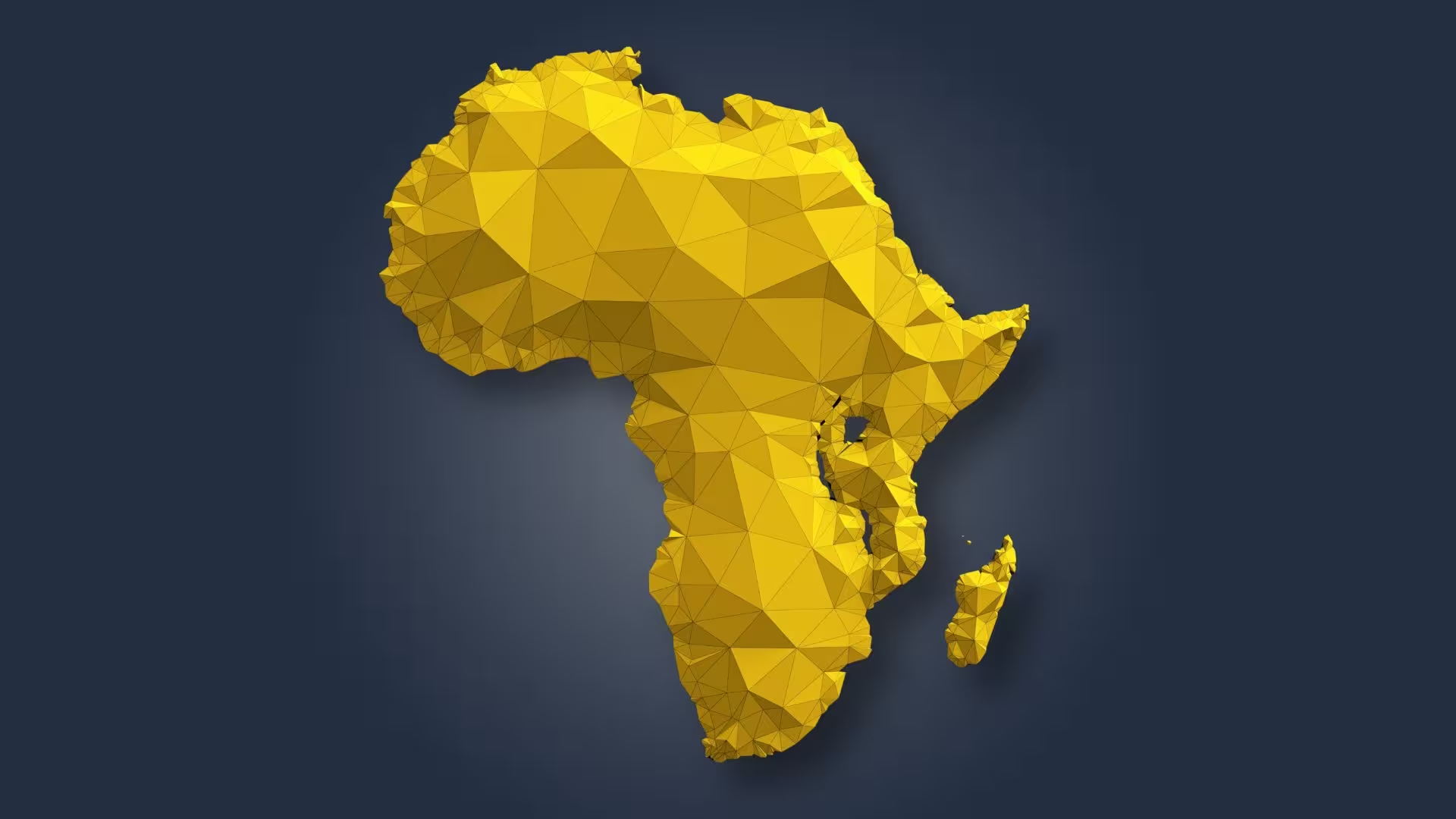
Africa stands at the heart of the global mining landscape in 2026. From cobalt in the Copperbelt to gold in West Africa and platinum in South Africa, the continent is home to the minerals that power everything from smartphones to renewable energy systems and electric vehicles. This immense resource base positions Africa as a critical supplier in a world racing toward decarbonization and digital transformation.
Yet, alongside this promise come pressing challenges. The sector is navigating an increasingly complex environment shaped by shifting regulations, fragile infrastructure, and growing environmental and social pressures. Recent events, including mining code disputes in Mali, persistent power shortages in South Africa, and a catastrophic dam collapse in Zambia, highlight just how vulnerable mining operations remain.
These challenges are not just industry hurdles; they shape how much African nations can benefit from their mineral wealth. Without addressing governance gaps, infrastructure bottlenecks, and sustainability risks, Africa risks missing out on the opportunity to anchor itself firmly within global supply chains for critical minerals.
We will explore the top 3 Challenges Facing the Mining Sector in Africa in 2026, offering insights into the barriers that investors, policymakers, and communities must overcome to ensure the continent’s resources fuel inclusive and sustainable growth.
KEY TAKEAWAYS
- Regulatory Shifts: New mining codes and unpredictable policy changes create uncertainty but also open space for stronger local participation.
- Infrastructure Gaps: Poor transport links and unstable power drive up costs, highlighting the need for investment in African-built solutions.
- Environmental Pressures: Tailings dam failures and unsafe artisanal practices demand stricter oversight and sustainable approaches.
- Investor Opportunities: Growing demand for critical minerals and local value addition make Africa a prime destination for bold, long-term investment.
1. Regulatory Uncertainty & Building African Ownership
Across the continent, governments are taking bold steps to reform mining laws with the goal of securing greater benefits for their citizens. These reforms often increase royalties, strengthen state participation, or require higher levels of local ownership. In Mali, for example, the government has introduced new mining codes designed to capture more value from its gold sector. While such measures have created tensions with some international companies, they reflect a growing determination by African states to ensure their resources deliver tangible national benefits.
For decades, Africa’s mining sector has relied heavily on foreign capital, leaving much of the value generated to flow abroad. This model has created vulnerabilities, as sudden shifts in global markets or investor withdrawals can destabilize entire economies. The path forward requires mobilizing more African investment, from local banks, pension funds, and private equity, to build truly homegrown mining champions. Strengthening regional partnerships and financing structures will reduce dependence on foreign investors while keeping more wealth circulating within African economies.
At the same time, true transformation depends on local value addition. Exporting raw minerals has kept African countries at the bottom of global value chains. By refining gold into bullion, processing cobalt into sulphates, or transforming bauxite into aluminum locally, Africa can create jobs, build industries, and secure a stronger foothold in global supply chains, especially those linked to clean energy and electric vehicles. In this context, regulatory reforms should not just be seen as barriers, but as opportunities to shift the balance of power toward African ownership and sustainable development.
2. Infrastructure Gaps & Energy Challenges
Infrastructure has long been both a challenge and an opportunity for Africa’s mining sector. In many mineral-rich regions, poor roads, limited rail networks, and congested ports drive up costs and restrict access to global markets. Energy shortages compound the problem, leaving mining companies struggling with unreliable power supplies. These bottlenecks make operations more expensive and limit the full potential of Africa’s vast resource wealth.
Yet, these gaps also highlight where Africa’s greatest opportunities lie. By investing in modern transport corridors, renewable power, and local processing hubs, African nations can reduce dependence on foreign-controlled logistics and create integrated value chains that keep more wealth at home. Such investments would not only serve mining but also stimulate trade, agriculture, and manufacturing, making them cornerstones of broader economic growth.
In South Africa, rising energy costs and persistent load shedding are pushing companies to seek alternatives, with many turning to renewables and hybrid power solutions. This shift, though initially costly, is spurring innovation and opening pathways for more sustainable, locally managed energy systems across the continent. Rather than being viewed only as constraints, Africa’s infrastructure and energy challenges can become the driving force for long-term resilience and self-reliance.
Turn Insight Into Action
We help investors, developers, and institutions move from ideas to bankable, de-risked projects across African markets.
Let’s turn your next investment into a structured success.
3. Environmental & Social Risks
Environmental challenges remain one of the most urgent issues facing Africa’s mining sector in 2026. Mining operations, when poorly managed, can lead to pollution, deforestation, and severe ecological damage. The 2025 tailings dam collapse in Zambia, which released an estimated 50 million liters of toxic waste into the Kafue River, is a stark reminder of these risks. The disaster devastated aquatic ecosystems, disrupted agriculture, and threatened the drinking water of millions, underscoring how fragile local communities remain in the face of mining-related accidents.
Beyond large-scale industrial operations, the artisanal and small-scale mining (ASM) sector also poses significant environmental risks. With limited access to technology and safety equipment, artisanal miners often use mercury and other hazardous practices, contaminating soils and waterways. These methods not only endanger the environment but also create long-term health consequences for mining communities. The lack of oversight allows unsafe practices to persist, particularly affecting vulnerable groups such as women and children who make up a large part of ASM’s workforce.
However, the problem is not simply one of risk, it is also an issue of lost opportunity. With better regulation, access to cleaner technology, and stronger community engagement, artisanal mining could transform into a driver of inclusive growth. By formalizing ASM and providing training in safer, more sustainable methods, African governments can protect the environment while also ensuring miners earn fairer incomes. Local refining and value addition would further reduce dependence on harmful raw extraction practices while creating new industries around processing and manufacturing.
Looking ahead, Africa must adopt a dual strategy: strengthening environmental safeguards for large-scale industrial operations while empowering artisanal miners with tools and education to mine responsibly. Mining should never come at the cost of human health or ecological stability. If managed with foresight and accountability, Africa’s resource wealth can become a force for sustainable development rather than a source of environmental harm.
4. The “Bankability” Filter
Turning ESG and Traceability into a Competitive Advantage
In 2026, the definition of a “bankable” mining project in Africa has undergone a fundamental shift. Institutional investors, particularly those from the EU and North America, no longer view Environmental, Social, and Governance (ESG) criteria as a “nice-to-have” corporate social responsibility (CSR) metric. Instead, ESG has become a hard financial filter that dictates the cost of capital and insurance premiums.
Digital Traceability as a Risk-Mitigation Tool
The most significant barrier to investment in 2025 was the “transparency gap” regarding mineral origins. In response, leading African mining hubs are now integrating Blockchain-backed traceability and Satellite-based environmental monitoring. By providing real-time data on carbon footprints, water usage, and labor conditions, operators are able to:
- Command Price Premiums: Refined products with certified green credentials (such as “Low-Carbon Copper”) are accessing premium markets in the EV and AI sectors.
- Lower Insurance Costs: Digital auditing of tailings dam stability and reforestation efforts reduces the risk profile for global underwriters.
Shifting from Compliance to Asset Quality
For BOH Infrastructure clients, Regulatory Compliance is now being rebranded as “Market Access Infrastructure.” Projects that proactively align with the Nigeria Data Protection Act and international Critical Mineral Traceability standards are experiencing systematically lower regulatory disruption.
In this new landscape, a project’s “Bankability” is no longer measured solely by the grade of ore in the ground, but by the transparency of the data flowing from the site. Companies that treat ESG as a core engineering discipline, rather than a legal burden, are successfully attracting the $1 trillion in domestic and global “green” capital currently seeking high-yield, low-risk African exposure.
5. The Rise of Regional Value Chains
Bridging Infrastructure Gaps via AfCFTA Integration
In previous market cycles, an “infrastructure gap”, such as a missing rail link or an inefficient port, was viewed as a terminal risk for a specific mining project. In 2026, the African Continental Free Trade Area (AfCFTA) has fundamentally changed this calculus by enabling the rise of Regional Value Chains (RVCs).
From “Pits-to-Port” to “Regional Hubs”
The traditional colonial-era infrastructure model was linear: moving raw ore from a landlocked pit directly to a coastal port for export. The AfCFTA framework is dismantling this inefficient “silo” approach. By harmonizing trade protocols and lowering cross-border tariffs, the agreement allows landlocked mineral wealth to flow to regional industrial hubs for processing before reaching the global market.
Closing the Gap through Shared Assets
The AfCFTA makes large-scale infrastructure projects “bankable” by aggregating demand across multiple borders. For example:
- Shared Processing Power: Instead of every mining nation building its own high-cost, underutilized smelter, the AfCFTA facilitates the creation of regional smelting hubs (e.g., in the Copperbelt or West African Gold zones) that serve multiple neighboring countries.
- Energy Pooling: Infrastructure gaps in power are being bridged by regional power pools, where mining operations in one country can be powered by surplus renewable energy generated in another, de-risking the entire regional supply chain.
The Strategic Dividend for Investors
For the BOH Infrastructure institutional client, the AfCFTA serves as a macro-hedge against localized infrastructure failure. If a specific national port faces congestion, the integrated trade corridors established under the AfCFTA provide “multi-modal” alternatives, allowing commodities to be rerouted through regional rail-to-road interchanges.
The Infrastructure Gap is no longer just a challenge to be solved; it is the primary entry point for investors to build the connectivity assets, data centers, smart logistics, and energy grids, that will define the next decade of African industrialization.
6. The Domestic Capital Revolution
Unlocking the $1 Trillion Pension Fund Dividend
For decades, the primary constraint on African mining and infrastructure projects was a heavy reliance on volatile foreign direct investment (FDI) and US Dollar-denominated debt. In 2026, a structural shift is occurring: the “Domestic Capital Revolution.” With over $1 trillion in assets currently held by African pension funds, the focus has moved toward mobilizing local currency to finance long-term industrial assets.
Mitigating Currency and Sovereign Risk
The pivot toward domestic capital is a strategic response to the currency devaluation risks that often plague foreign-funded projects. By utilizing local capital for local infrastructure:
- Currency Matching: Projects generate revenue in local currency and service debt in the same currency, eliminating the “devaluation trap” that occurs when a national currency slides against the USD.
- Political De-risking: When local pension funds, representing the savings of a nation’s citizens, are “anchor investors” in a mine or rail corridor, the political cost of regulatory interference rises significantly. This creates a “sovereign shield” that protects the project’s long-term stability.
The Infrastructure Bond as a Preferred Instrument
To facilitate this flow of capital, BOH Infrastructure has observed the rise of Infrastructure Bonds as the primary vehicle for institutional participation. These bonds allow local funds to invest in “bankable” segments of the value chain (like a dedicated power plant for a copper mine) without taking on the high-risk profile of the mining exploration itself.
A New Era of Public-Private Partnerships (PPPs)
The success of the “Domestic Capital” model relies on the technical structuring of PPPs. In 2026, we are seeing “Blended Finance” structures where local institutional capital provides the stable base, while international DFIs (Development Finance Institutions) provide first-loss guarantees or technical expertise.
For the mining sector, this means that the next generation of “homegrown champions”, African-owned processing plants and refineries, are no longer waiting for global approval. They are being built, owned, and financed by African capital, ensuring that the wealth generated from the continent’s minerals stays within the regional ecosystem.
Conclusion
A Mining Future Defined by Resilience and Self-Reliance
The landscape of African mining in 2026 is no longer defined merely by the abundance of resources, but by the sophistication of the frameworks built around them. While regulatory shifts, infrastructure gaps, and environmental risks remain significant hurdles, they have catalyzed a fundamental transformation in how the continent approaches its mineral wealth.
By shifting the focus from raw extraction to localized beneficiation, African nations are moving up the global value chain. The implementation of the AfCFTA has effectively turned isolated infrastructure challenges into integrated regional opportunities, while the mobilization of domestic pension funds has provided a stable, currency-matched foundation for long-term project finance. Furthermore, the rise of digital traceability has transformed ESG from a compliance burden into a powerful tool for bankability and market access.
For the forward-thinking institutional investor, the message is clear: the most significant “de-risking” in Africa is now happening from within. The future of mining on the continent belongs to those who align their capital with this new era of African industrialization, one that prioritizes sustainability, local ownership, and the strategic integration of the world’s most critical supply chains. At BOH Infrastructure, we remain committed to bridging the gap between these high-potential assets and the structured, bankable frameworks required to turn vision into reality.
Turn Insight Into Action
We help investors, developers, and institutions move from ideas to bankable, de-risked projects across African markets.
How We Support You
- Validate opportunities with on-the-ground intelligence
- Structure investments to manage risk and attract capital
- Connect you with trusted partners, financiers, and advisors
- Navigate regulatory, financial, and operational complexity
Why It Matters
Opportunities don’t fail because they lack potential, they fail because they’re not structured to succeed.
Partner with BOH Infrastructure to unlock strategic opportunities in Africa.
Let’s turn your next investment into a structured success.
Have you read?
De-risking African Infrastructure Investment
Ghost Projects and How to Avoid Them
Public-Private Partnerships PPPs: The Future of Infrastructure in Emerging Markets
Share this post:
Know someone who needs to see this? Share it with them!
Ready to explore opportunities in one of Africa’s fastest-growing markets?
Investment
Opportunities in
Africa in 2026
We provide expert guidance on market entry, due diligence, and business development support.
FAQ: Navigating the African Mining Landscape in 2026
How is the AfCFTA solving infrastructure gaps in the mining sector?
The AfCFTA facilitates the creation of regional industrial hubs, allowing landlocked mines to process minerals in neighboring countries. This aggregates infrastructure demand, making cross-border rail, road, and energy projects more bankable through shared usage.
Why is domestic capital becoming the preferred funding source for African mining?
Local currency financing from African pension funds and infrastructure bonds eliminates “devaluation risk”—where projects earn local currency but owe USD debt. It also provides a “sovereign shield,” as local institutional ownership reduces the likelihood of regulatory interference.
What role does blockchain play in 2026 mining operations?
Blockchain is used for mineral traceability, providing a digital “passport” for ores like cobalt and lithium. This transparency allows African producers to command a price premium in global markets by proving compliance with ESG and labor standards.
Is regulatory uncertainty still a major risk for investors?
While mining codes are evolving to favor local beneficiation, this “uncertainty” actually creates a barrier to entry that rewards early movers. Investors who partner with local entities and prioritize value-addition are finding a more stable, long-term regulatory environment.
How can mining companies mitigate energy shortages in South Africa and the Copperbelt?
Many operations are transitioning to “Captive Power” models, becoming independent power producers (IPPs) using hybrid solar-wind-battery systems. This ensures 24/7 uptime and significantly lower long-term ESG footprints compared to national grid reliance.
