The Rise of Green Hydrogen in Namibia and Morocco Africa’s New Export Frontier
Updated March 2, 2026
Africa’s commodity export history has followed a familiar and frustrating arc: raw materials leave the continent, value is added elsewhere, and the financial returns accumulate in other jurisdictions. Green hydrogen is being positioned, by governments, development finance institutions, and a growing number of private developers, as the commodity that breaks that pattern.
The argument is straightforward. Africa holds an extraordinary endowment of solar irradiation and wind resources, particularly along the Atlantic and Mediterranean coastlines, that can produce renewable electricity at costs well below the global average. Green hydrogen produced from that electricity, and exported to energy-hungry markets in Europe, Japan, and South Korea, would for the first time place Africa at the upstream end of a high-value global supply chain rather than at the raw material extraction end.
Namibia and Morocco are the two countries furthest along this path. Their approaches differ significantly, one is building from a near-zero industrial base with vast land resources, the other is leveraging mature renewable infrastructure and deep European relationships, but both illuminate what it takes to translate natural resource endowment into investable, bankable green hydrogen projects.
KEY TAKEAWAYS
- Namibia’s Hyphen Hydrogen Energy project and Morocco’s Nour and Aman projects represent two of the most advanced green hydrogen initiatives on the African continent, each backed by significant European capital.
- The European Union’s dependence on imported energy, sharpened by the 2022 Russia-Ukraine conflict, has made African green hydrogen a geopolitical priority, not just an investment theme.
- Green hydrogen production economics depend heavily on the cost of renewable electricity, both Namibia and Morocco have exceptional solar and wind resources that place their production costs at the competitive frontier.
- The Power-to-X model, converting hydrogen into ammonia or methanol for easier transport, is the dominant export strategy because liquefied hydrogen shipping infrastructure does not yet exist at commercial scale.
- Port infrastructure, water desalination, and dedicated transmission grids are the three enabling investments that will determine which projects reach financial close first.
DEFINITION
Green hydrogen is hydrogen gas produced through electrolysis, the splitting of water molecules into hydrogen and oxygen using electrical current. When that electricity comes from renewable sources such as solar, wind, or geothermal, the process produces no carbon emissions, yielding a fuel that is clean across its entire production chain.
The broader Power-to-X economy extends this concept: green hydrogen can be converted into ammonia (for fertiliser and shipping fuel), methanol (for chemicals and transport), synthetic aviation fuel, or liquefied hydrogen for direct export. In each case, the underlying asset is surplus renewable electricity, converted into a tradeable energy carrier that can be shipped globally.
Table of Content
The Rise of Green Hydrogen in Namibia and Morocco: Africa’s New Export Frontier
This article is in BOH Infrastructure’s 2026 Energy and the Green Transition series. The full series establishes that Africa’s energy deficit is overwhelmingly a financing and perception problem rather than a resource one. This briefing focuses on the specific assets, corridors, and technologies that translate that argument into investable, bankable energy infrastructure.
Why Europe’s Energy Crisis Reshaped the African Hydrogen Map
Before February 2022, green hydrogen was a credible but distant ambition in most European energy planning documents. The invasion of Ukraine and the subsequent disruption of Russian gas supply to Europe compressed a decade of energy transition planning into roughly eighteen months. Governments that had been cautiously piloting hydrogen strategies were suddenly mandating import targets, signing memoranda of understanding with supplier nations, and allocating public capital to de-risk early projects.
The European Union’s REPowerEU plan, published in May 2022, set a target of importing 10 million tonnes of green hydrogen annually by 2030. Africa, particularly the northern and southern Atlantic coastlines, sits within viable shipping or pipeline distance of major European import terminals. Germany signed hydrogen cooperation agreements with Namibia, Morocco, South Africa, and Kenya in the same 18-month window. The Netherlands signed with Morocco. Spain, already connected to Morocco by an existing gas pipeline corridor, began feasibility studies on hydrogen blending and dedicated hydrogen pipelines.
This geopolitical context matters for the investment analysis. Green hydrogen projects in Africa are not purely commercial propositions priced against spot energy markets. They carry strategic value for European governments that are willing to deploy concessional finance, export credit guarantees, and diplomatic weight to accelerate specific projects. This blended finance dimension substantially changes the risk-return calculus for co-investing private capital.
Namibia
Building an Industry from the Ground Up
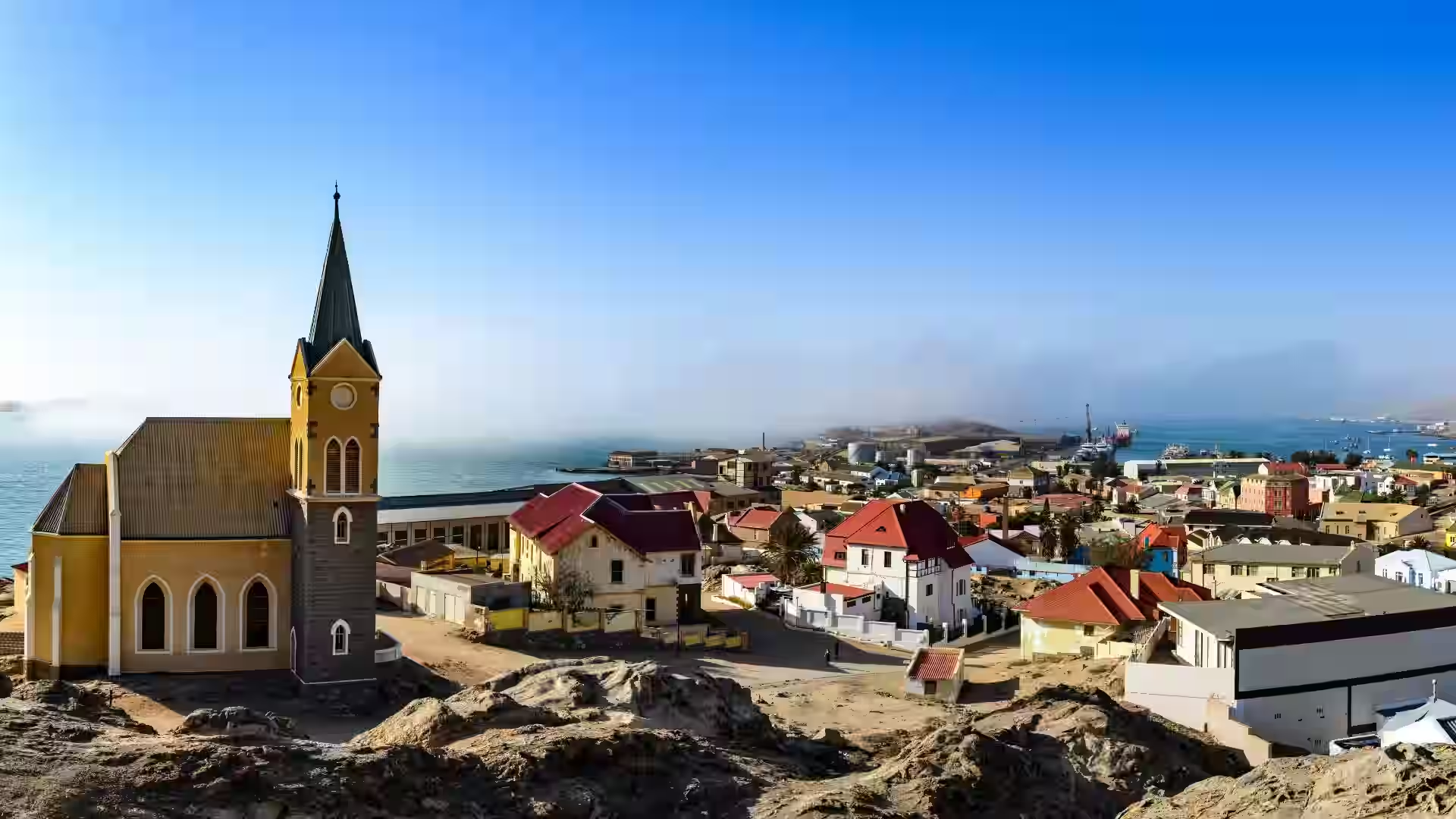
Namibia’s green hydrogen story is striking precisely because the country had almost no prior renewable energy export infrastructure when the conversation began. What it does have is an Atlantic coastline with some of the highest and most consistent wind speeds on earth, vast uninhabited interior land with exceptional solar irradiation, and a stable, investor-friendly governance framework that has received consistently high marks from international credit rating agencies relative to its regional peers.
The flagship project is Hyphen Hydrogen Energy, a joint venture between Nicholas Holdings and Enertrag that was awarded development rights over a 4,000 square kilometre zone in the Tsau Khaeb National Park in southern Namibia, adjacent to the port of Luderitz. The project’s ambition is extraordinary in scale: at full build-out, it targets 3 GW of electrolyser capacity producing up to 300,000 tonnes of green hydrogen annually, most of it converted to ammonia for export. Capital expenditure estimates have ranged from USD 10 billion to USD 15 billion over the full development cycle.
For context, that investment figure exceeds Namibia’s annual GDP. It will not be financed by a single institution or through a conventional project finance structure. The Namibian government, advised by the African Development Bank and the German development finance institution KfW, has structured the project to attract layered capital: sovereign wealth fund equity, development finance institution debt at concessional rates, export credit agency guarantees from European governments whose industries will benefit from the ammonia offtake, and commercial bank debt for the portions of the project with the clearest revenue visibility.
The Luderitz port is the critical infrastructure choke point. Currently a small fishing harbour, it requires substantial investment in deep-water berth capacity, ammonia storage terminals, and dedicated loading infrastructure before the first export cargo can leave. Namibia’s government has secured preliminary commitments from the German government’s development finance arm and from the European Investment Bank for port expansion funding, but construction timelines are tight against the 2030 offtake targets that anchor the project’s revenue model.
Water is the other constraint that investors must understand carefully. Electrolysis consumes approximately nine litres of water per kilogram of hydrogen produced. At the scale Hyphen is targeting, freshwater demand would exceed Namibia’s available surface water resources in the project area by several orders of magnitude. The solution is seawater desalination, powered by dedicated renewable capacity, but the desalination plants themselves represent a multi-billion dollar capital requirement and introduce additional operational complexity into an already technically sophisticated value chain.
Morocco
The Industrialised Hydrogen Pioneer
Morocco’s position is fundamentally different from Namibia’s. The country already has over 4 GW of installed renewable energy capacity, a functioning electricity grid interconnected with Spain, an established industrial base in phosphates and fertilisers through the OCP Group, and a track record of executing large-scale infrastructure projects on time and within budget that few African nations can match.
The Nour and Aman projects, developed under Morocco’s National Green Hydrogen Roadmap published in 2021, target initial production of 4 TWh of renewable electricity dedicated to hydrogen by 2027, scaling to 20 TWh by 2030. The OCP Group, one of the world’s largest phosphate and fertiliser companies, has positioned itself as the anchor industrial consumer of Moroccan green hydrogen, using it to produce green ammonia for its fertiliser plants. This is a direct import substitution play that reduces OCP’s dependence on imported natural gas for ammonia synthesis.
Morocco’s geographic position is its most distinctive advantage for European export. The country shares a land border with the Spanish enclave of Ceuta, and the existing Maghreb-Europe Gas Pipeline runs from Algeria through Morocco to Spain and Portugal. While this pipeline is currently configured for natural gas, the physical infrastructure provides a template for a future dedicated hydrogen pipeline corridor. That corridor would dramatically reduce the cost and complexity of European hydrogen imports compared to shipping liquefied hydrogen or ammonia from southern Africa.
The Xlinks Morocco-UK Power Project, while primarily a renewable electricity export project rather than a pure hydrogen play, illustrates the depth of European appetite for Moroccan energy assets. The project proposes a 3,800 kilometre subsea cable carrying solar and wind electricity from Morocco directly to the United Kingdom. If commercially validated, it confirms Morocco’s credentials as a multi-pathway renewable energy exporter capable of attracting institutional capital at scale.
Morocco also benefits from its relationship with the European Bank for Reconstruction and Development, the European Investment Bank, and bilateral development finance from France, Germany, and the Netherlands. These institutions have long track records of financing Moroccan infrastructure and understand the country’s regulatory and contractual environment, reducing the due diligence burden and accelerating decision timelines for private co-investors.
The Power-to-X Economics
What Makes a Project Bankable
Neither liquefied hydrogen shipping nor pipeline hydrogen at commercial scale exists today at the volumes required by 2030 offtake targets. This is why the Power-to-X conversion step, producing ammonia, methanol, or synthetic fuels rather than shipping pure hydrogen, is central to almost every near-term African green hydrogen export project.
Ammonia is the most commercially mature pathway. It is already traded globally at scale, with established shipping infrastructure, storage terminals, and industrial end users. Green ammonia, produced from green hydrogen, can enter existing ammonia supply chains with minimal modification to the receiving infrastructure. It can also be used directly as a shipping fuel, a use case gaining regulatory support in the International Maritime Organization’s decarbonisation framework.
The economics of green ammonia production in Namibia and Morocco hinge on three cost variables: the levelised cost of renewable electricity, the capital cost of electrolysers, and the cost of financing. On the first variable, both countries are genuinely advantaged. Solar and wind resources capable of generating electricity at USD 0.02 to USD 0.04 per kilowatt-hour place their production costs at the low end of the global range. Electrolyser costs have fallen by approximately 60 percent over the past five years and are projected to fall further as manufacturing scale increases. Financing cost is the variable most sensitive to project-specific risk perception, and it is here that the blended finance structures being assembled by development finance institutions are doing the most work.
A project that achieves a blended cost of capital of 7 to 8 percent, through combining concessional development finance with commercial debt and equity, can produce green ammonia at costs that are competitive with grey ammonia (produced from natural gas) at current European gas prices. Projects that must finance entirely at commercial rates face a harder economics case, particularly as gas prices have moderated from their 2022 peaks. This is why the composition of the financing stack is not a secondary question for investors. It is the primary determinant of whether a project proceeds.
The Enabling Infrastructure Imperative
No green hydrogen project in Africa will reach financial close without resolving three enabling infrastructure requirements simultaneously: port capacity, water supply, and dedicated renewable power and transmission.
Luderitz in Namibia and the Atlantic port of Jorf Lasfar in Morocco are both receiving infrastructure investment commitments, but the scale and speed of port development will be the most visible near-term indicator of project momentum. Investors watching these projects should track port construction milestones as a leading indicator of overall project viability.
Desalination, as noted in the Namibia context, is not optional. It is a core project component that must be sized, financed, and contracted alongside the electrolyser and renewable generation capacity. Projects that treat desalination as a secondary concern are underestimating a material cost and execution risk.
Dedicated renewable generation, separate from the national grid, is the preferred structure for most export projects because it allows for direct renewable energy certification of the hydrogen produced. This certification is increasingly required by European import regulations under the EU’s Renewable Energy Directive. Grid-connected production introduces certification complexity that some offtake agreements are not yet structured to absorb.
Investor Positioning
Where the Opportunities Lie
For institutional investors, the direct equity opportunities in early-stage green hydrogen projects carry significant execution and technology risk. The more immediately accessible opportunities are in the enabling infrastructure layer: port development, desalination plant construction and operation, logistics and storage, and the manufacturing supply chain for electrolysers and balance-of-plant equipment.
Sovereign wealth funds from the Gulf Cooperation Council are already active in this space, with ADNOC, Mubadala, and Saudi Aramco’s investment arms all evaluating African green hydrogen positions. Their appetite is driven partly by the recognition that green hydrogen represents a long-term structural shift in global energy trade and partly by the opportunity to diversify energy export portfolios beyond hydrocarbons.
For private equity and infrastructure funds, the most defensible entry point is probably the operational phase of projects that have passed final investment decision, accepting lower headline returns in exchange for substantially reduced construction and regulatory risk. The first wave of African green hydrogen projects reaching this stage is likely to occur between 2026 and 2029.
Turn Insight Into Action
We help investors, developers, and institutions move from ideas to bankable, de-risked projects across African markets.
Let’s turn your next investment into a structured success.
This article is part of Energy and the Green Transition series. The full series establishes that Africa’s energy deficit is overwhelmingly a financing and perception problem rather than a resource one. This briefing focuses on the specific assets, corridors, and technologies that translate that argument into investable, bankable energy infrastructure. Read the full Energy and the Green Transition series.
Within this series:
- Kenya’s low-cost geothermal electricity positions it as a future green hydrogen producer alongside North and Southern African pioneers. → Read The Rise of Green Hydrogen in Namibia and Morocco: Africa’s New Export Frontier
- Geothermal baseload reduces Africa’s dependence on battery storage as a grid stabiliser, but hybrid systems combining geothermal and storage are emerging. → Read Battery Storage and Grid Resilience: Solving the Intermittency Gap in 2026
- Kenya’s low-cost geothermal electricity positions it as a complementary green hydrogen producer to Namibia and Morocco, with a different feedstock profile and a primarily domestic industrialisation focus in the near term. → Read Kenya’s Geothermal Advantage: A Blueprint for Regional Energy Security
Related Articles
- The blended finance structures being developed for green hydrogen projects draw on the same multilateral and domestic capital mobilisation logic that underpins AfCFTA infrastructure financing. The risk-sharing models being pioneered in hydrogen are directly transferable to cross-border transport and energy infrastructure. → Read Financing the AfCFTA: The Role of Infrastructure Bonds and Domestic Pension Funds
- Tanger Med is directly relevant to Morocco’s green hydrogen export ambitions. Port infrastructure investment is the most immediate physical constraint on green hydrogen project timelines in both Namibia and Morocco, and the lessons from Tanger Med’s modernisation programme apply directly to Luderitz and Jorf Lasfar. → Read Port Modernization: Lessons from Tanger Med and Mombasa in 2026
Have you Read?
De-risking African Infrastructure Investment
Public-Private Partnerships PPPs: The Future of Infrastructure in Emerging Markets
What is the AfCFTA? An Executive Overview for Global Investors
Turn Insight Into Action
We help investors, developers, and institutions move from ideas to bankable, de-risked projects across African markets.
How We Support You
- Validate opportunities with on-the-ground intelligence
- Structure investments to manage risk and attract capital
- Connect you with trusted partners, financiers, and advisors
- Navigate regulatory, financial, and operational complexity
Why It Matters
Opportunities don’t fail because they lack potential, they fail because they’re not structured to succeed.
Partner with BOH Infrastructure to unlock strategic opportunities in Africa.
Let’s turn your next investment into a structured success.
FAQ: Green Hydrogen in Namibia and Morocco
What is green hydrogen and why is Africa well placed to produce it?
Green hydrogen is hydrogen produced through electrolysis powered entirely by renewable energy, resulting in zero carbon emissions across the production chain. Africa is well placed to produce it because the continent holds some of the world’s highest solar irradiation levels and strongest wind resources, particularly along the Atlantic and Mediterranean coastlines, enabling very low-cost renewable electricity generation, the primary input cost in hydrogen production.
What is the Power-to-X economy and how does it relate to African exports?
Power-to-X refers to converting surplus renewable electricity into storable and transportable energy carriers. For Africa, the most commercially viable pathways are converting green hydrogen into ammonia (for fertiliser and shipping fuel) or methanol (for chemicals and marine fuel). These carriers can be exported using existing global commodity shipping infrastructure, making them more practical than shipping pure liquefied hydrogen, which requires specialised cryogenic vessels not yet available at commercial scale.
What is the Hyphen Hydrogen Energy project in Namibia?
Hyphen Hydrogen Energy is a joint venture developing a large-scale green hydrogen and ammonia production facility in southern Namibia, adjacent to the port of Luderitz. It targets up to 3 GW of electrolyser capacity producing 300,000 tonnes of green hydrogen annually at full build-out. The project is structured around layered blended capital from sovereign, multilateral, and commercial sources, with German development finance playing a significant anchoring role.
How does Morocco differ from Namibia as a green hydrogen producer?
Morocco has material advantages in existing renewable energy infrastructure, industrial capacity through the OCP Group, geographic proximity to European markets via existing pipeline corridors, and deep institutional relationships with European development finance. Namibia’s advantage lies in its exceptional wind and solar resources and vast available land, but it is building export capacity largely from scratch. Morocco is closer to near-term commercial production; Namibia’s scale ambition is larger but carries a longer lead time.
What role does the European Union play in African green hydrogen development?
The EU’s REPowerEU plan targets importing 10 million tonnes of green hydrogen annually by 2030 to reduce dependence on Russian fossil fuels. This has translated into bilateral cooperation agreements between European governments and African producers, concessional finance deployment from the European Investment Bank and KfW, and the development of import certification frameworks under the EU Renewable Energy Directive that define qualifying green hydrogen for European market access.
What are the main investment risks in African green hydrogen projects?
The principal risks are: technology and execution risk in first-of-kind projects at unprecedented scale; financing risk if concessional capital is insufficient to bring blended costs of capital to competitive levels; market risk if European gas prices fall and reduce the premium for green over grey hydrogen; water supply risk in arid locations requiring large-scale desalination; and policy risk if European import certification standards shift in ways that disadvantage African producers.
When are African green hydrogen projects expected to reach commercial scale?
The most advanced projects, including Hyphen in Namibia and the Nour and Aman projects in Morocco, are targeting initial production between 2027 and 2030. Full commercial scale, meaning volumes sufficient to meaningfully supply European import demand, is more realistically a 2030 to 2035 timeline, contingent on port infrastructure completion, electrolyser supply chain development, and final investment decisions on the first phase of each project.
Share this post:
Know someone who needs to see this? Share it with them!
Ready to explore opportunities in one of Africa’s fastest-growing markets?
Investment
Opportunities in
Africa in 2026
We provide expert guidance on market entry, due diligence, and business development support.