
Tanzania 2026: Analyzing the Technical De-risking Frameworks Driving a Mining Renaissance
How Tanzania is transforming from a traditional gold producer into a critical minerals powerhouse driving the global clean energy revolution
Updated March 28, 2026

Tanzania is undergoing a fundamental structural transformation that extends far beyond its heritage as a Tier-1 gold producer. While the nation maintains its status as Africa’s fourth-largest gold exporter, the 2026 landscape is defined by a strategic pivot toward critical minerals, graphite, lithium, and rare earth elements (REEs), that sit at the center of the global clean energy transition.
This evolution is underpinned by a sophisticated de-risking of the investment environment. By integrating the Standard Gauge Railway (SGR) for seamless pit-to-port logistics and leveraging the Julius Nyerere Hydropower Project for low-carbon operational power, Tanzania is positioning itself as the premier bankable mining jurisdiction in East Africa. With the mining sector’s contribution to GDP reaching 10.1% in 2024, the focus has shifted from mere resource discovery to the industrial delivery of high-value, processed minerals for the global market.
KEY TAKEAWAYS
- Tanzania’s mining transformation builds on a strong gold legacy, with over 500,000 employed and over 55 tonnes of gold produced annually, laying the groundwork for a booming critical minerals sector.
- The country ranks 6th globally in graphite reserves, with world-class projects like Mahenge and Lindi Jumbo positioning Tanzania as a vital supplier for electric vehicle and battery technologies.
- Tanzania is emerging as a new lithium frontier, with exploration in Dodoma and a ban on raw lithium exports encouraging local processing and value addition.
- Rare earth elements like neodymium and praseodymium add high-tech potential, as the Ngualla project attracts major foreign investment and diversifies global supply chains.
- Critical mineral projects are integrating renewable energy solutions, supporting Tanzania’s Vision 2050 goal of 50% clean energy and aligning mining with green economy objectives.
- The shift to critical minerals is driving skills development, industrial processing, and infrastructure upgrades, creating lasting economic benefits beyond the mining sector.
- Tanzania’s political stability and responsible governance attract global partners, including its participation in the Minerals Security Partnership to support secure, sustainable mineral supply chains.
- While challenges remain, such as technical capacity and infrastructure demands, Tanzania is positioned to leapfrog traditional barriers by adopting advanced technologies and sustainable practices from the start.
Table of Content
Technical De-risking
Infrastructure Connectivity and Regulatory Stability
In 2026, the primary concern for institutional investors in Tanzania has shifted from “geological risk” (whether the minerals are there) to “execution risk” (how they reach the global market). To address this, Tanzania has implemented a multi-layered de-risking framework that connects inland resources to global supply chains with high efficiency.
1. Logistics De-risking
The SGR and Port Integration
The Standard Gauge Railway (SGR) is the single most important technical de-risker for the Tanzanian mining sector. Historically, transporting heavy mineral concentrates like graphite and copper by road was a high-cost, high-risk bottleneck. The SGR integration provides:
- Direct Mine-to-Port Rail Links: Projects in the interior, such as those in the Dodoma and Mahenge regions, now have a high-capacity, electrified rail connection directly to the Port of Dar es Salaam.
- Reduced Operational Expenditure (OpEx): Rail transport reduces logistics costs by an estimated 40% compared to traditional road haulage, significantly improving the internal rate of return (IRR) for graphite and lithium juniors.
- Capacity for Scale: The port’s recent expansion ensures that as production scales at world-class sites like Lindi Jumbo, there is sufficient gantry and berth capacity to manage specialized mineral containers.
2. Regulatory De-risking
Framework Agreements and MSP
Tanzania has moved away from the “stroke of a pen” risk of the previous decade by adopting Framework Agreements. These agreements, signed with major global players like Rio Tinto and Barrick, create a stable, multi-year fiscal and legal environment.
- MSP Alignment: Tanzania’s participation in the Minerals Security Partnership (MSP) provides an international audit trail for ESG compliance. This acts as a “green light” for Tier-1 financiers who require strict adherence to environmental and labor standards before committing capital.
- Stabilization Clauses: Modern contracts now include stabilization clauses that protect investors against sudden changes in tax or royalty structures, ensuring the long-term bankability of large-scale projects.
3. Energy De-risking
The Hydropower Dividend
Energy stability is a core technical de-risker. The Julius Nyerere Hydropower Project has introduced massive amounts of clean, cheap baseload power into the national grid. For energy-intensive operations like graphite processing and lithium refining, this translates to:
- Lower Carbon Footprints: Mines can now market their products as “Green Minerals,” commanding a price premium in the EU and US markets.
- Operational Continuity: A stable power supply eliminates the need for expensive diesel backup generators, further protecting the project’s bottom line from global fuel price volatility.

RELATED ARTICLE: Infrastructure and Trade Corridors.
Building on the Success of the Golden Foundation
Tanzania’s mining success story began with gold, and this foundation remains crucial to understanding the country’s current transformation. The sector employs over 500,000 people directly and has attracted billions in international investment, creating the infrastructure, expertise, and institutional capacity that now supports critical minerals development.
Major operations like Geita, North Mara, and Bulyanhulu have not only produced over 55 tonnes of gold annually but have also established Tanzania as a reliable mining jurisdiction with strong governance frameworks and environmental standards. This reputation is now attracting a new wave of investment focused on the minerals essential for batteries, electric vehicles, and renewable energy systems.
The lessons learned from gold mining, particularly around community engagement, environmental management, and local value addition, are being applied to critical minerals development with even greater sophistication. Tanzania’s approach recognizes that while gold built the foundation, critical minerals will define the future.
Powering the Battery Revolution
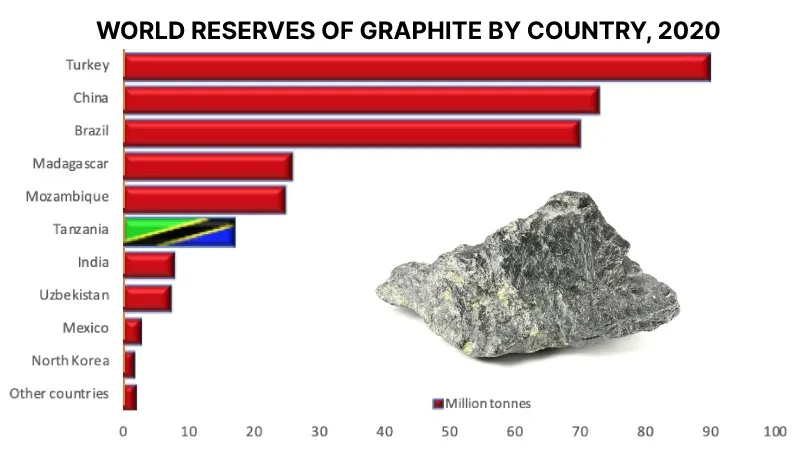
Tanzania ranks 6th globally in graphite reserves with 17 million tonnes, positioning the country as a key supplier for battery technology
Tanzania’s emergence as a critical player in the global battery supply chain begins with graphite, the unsung hero of the electric vehicle revolution. With 17 million tonnes of reserves ranking sixth globally, Tanzania possesses the raw materials essential for lithium-ion battery production, where graphite comprises up to 95% of the anode by weight.
The quality of Tanzania’s graphite deposits sets them apart in global markets. The high-grade, large-flake graphite found in projects like Mahenge, Bunyu, and Lindi Jumbo is particularly well-suited for battery applications, where these characteristics translate directly into superior battery performance and longer lifespans.
Mahenge – A World-Class Resource
The Mahenge Graphite Project exemplifies Tanzania’s potential in this sector. With 212 million tonnes of resources at 7.8% Total Graphitic Carbon, it represents one of the largest JORC-compliant flake graphite resources globally. The strategic importance of this project was underscored in September 2024 when South Korean steel and battery materials giant POSCO Group acquired a 19.9% stake, providing Tanzania with direct access to Asia’s battery supply chains.
Lindi Jumbo – First to Market
Tanzania achieved a significant milestone in 2024 when the Lindi Jumbo Graphite Project became the first major graphite operation to commence commercial production. With the highest reserve grade of any undeveloped graphite project in Africa at 17.9% Total Graphitic Carbon, Lindi Jumbo’s first exports to Europe marked a historic moment for Tanzania’s critical minerals sector.
The success of Lindi Jumbo demonstrates the commercial viability of Tanzania’s graphite resources and provides a template for other projects. The operation’s focus on producing premium-grade concentrates that command higher prices in international markets shows how Tanzania can capture maximum value from its mineral endowments.
The Lithium Frontier – Securing the Electric Future
While graphite provides the foundation, lithium represents Tanzania’s frontier opportunity in the battery materials market. Although less developed than the graphite sector, recent discoveries and the government’s strategic policy decisions suggest significant potential for Tanzania to become an important lithium producer.
Strategic Policy Leadership
Tanzania’s approach to lithium development demonstrates sophisticated resource governance. In 2023, the government implemented a ban on raw lithium exports, requiring local processing and value addition.
This bold policy decision reflects lessons learned from other countries’ experiences and ensures that Tanzania captures maximum value from its lithium resources rather than simply exporting raw materials.
Emerging Discoveries
Exploration activities in the Dodoma region have identified promising lithium deposits, with companies like CGrowth Capital securing multiple prospecting licenses and reporting encouraging results from field mapping exercises. Geological reports suggest potential deposits of at least 8 million tons of lithium ore, representing a substantial resource base for future development.
The proximity of these deposits to Tanzania’s capital city and existing infrastructure creates additional advantages for development. Unlike remote mining locations that require extensive infrastructure investment, the Dodoma region’s lithium potential can leverage existing transportation networks and power systems.

Advanced battery technology showing graphite’s critical role as anode material in lithium-ion batteries
The High-Tech Advantage
Rare Earth Elements
Tanzania’s critical minerals portfolio extends beyond battery materials to include rare earth elements, the specialized materials essential for wind turbines, electric vehicle motors, and advanced electronics. The Ngualla Rare Earth Project represents one of the largest, highest-grade neodymium-praseodymium deposits globally, positioning Tanzania to play a crucial role in diversifying global rare earth supply chains.
Currently dominated by Chinese production, the rare earth market faces supply chain vulnerabilities that have prompted international efforts to develop alternative sources. Tanzania’s Ngualla project, with its world-class resource and strategic partnerships, represents one of the most promising opportunities to address these supply chain challenges.
The strategic importance of this project attracted $667 million in investment agreements with Australian companies in April 2023, demonstrating international confidence in Tanzania’s rare earth potential. These investments bring not just capital but also technology transfer and market access that position Tanzania as a significant player in global rare earth markets.
Green Economy Integration
Tanzania’s critical minerals development is uniquely aligned with the country’s broader sustainability objectives. Unlike traditional commodity mining that often conflicts with environmental goals, critical minerals development directly supports the global clean energy transition while contributing to Tanzania’s own renewable energy targets.
Vision 2050 Alignment
The development of critical minerals fits perfectly within Tanzania’s Development Vision 2050, which envisions the country as a prosperous, industrialized nation with a strong emphasis on environmental stewardship. The vision’s call for Tanzanians to become “dedicated custodians of the environment” provides a framework for ensuring that mining development contributes to rather than undermines sustainability objectives.
Renewable Energy Synergies
Several critical mineral projects are incorporating renewable energy components into their development plans, creating synergies between mining development and clean energy deployment. These investments contribute to Tanzania’s goal of achieving 50% renewable energy generation by 2030 while demonstrating the commercial viability of renewable technologies.
The integration of solar and wind power systems in mining operations reduces environmental footprints while providing clean energy to local communities. This approach creates a virtuous cycle where mining for clean energy materials is powered by clean energy itself.
Turn Insight Into Action
We help investors, developers, and institutions move from ideas to bankable, de-risked projects across African markets.
Let’s turn your next investment into a structured success.
Economic Transformation Beyond Mining
The impact of Tanzania’s critical minerals development extends far beyond the mining sector itself. The emphasis on local value addition and processing is creating new industrial capabilities that have applications across the economy.
Skills and Technology Transfer
The development of graphite processing capabilities is creating expertise in advanced materials processing that can be applied to other industrial sectors. The technical knowledge, quality control systems, and supply chain management capabilities developed for battery materials production represent transferable skills that support broader industrial development.
Infrastructure Development
Critical minerals projects are driving substantial infrastructure investments that benefit the broader economy. Transportation corridors, power systems, and telecommunications networks developed for mining operations create capacity that serves other economic sectors and improves overall connectivity.
Employment and Innovation
The transition to critical minerals is creating new types of employment opportunities that require higher skill levels and offer better compensation than traditional mining activities. Processing operations for battery materials require expertise in chemistry, metallurgy, and advanced manufacturing, creating pathways for career advancement and skills development.
Tanzania’s Strategic Advantage for Global Positioning
Tanzania’s emergence as a critical minerals producer comes at a crucial time in global supply chain evolution. As countries and companies seek to diversify their supply chains away from single-source dependencies, Tanzania’s political stability, strong governance frameworks, and commitment to responsible mining practices make it an attractive partner.
The country’s participation in the Minerals Security Partnership, a coalition of 14 Western nations and the European Commission, provides access to technical expertise and financing specifically designed to support responsible critical mineral development. This partnership recognizes Tanzania’s strategic importance in global efforts to build resilient supply chains for clean energy technologies.
Regional Hub Potential
Tanzania’s strategic location and emerging processing capabilities position it to serve as a regional hub for critical mineral processing and distribution. The development of integrated value chains that combine Tanzania’s resources with those of neighboring countries could create economies of scale that improve competitiveness while distributing benefits across the region.
Challenges and Opportunities Ahead
While the opportunities are substantial, Tanzania’s critical minerals development also faces significant challenges that require careful management. Technical capacity building, infrastructure development, and environmental management all require sustained investment and attention.
The complexity of critical mineral processing demands sophisticated technologies and expertise that are currently limited in Tanzania. Building these capabilities will require substantial investments in technology transfer, skills development, and international partnerships.
However, these challenges also represent opportunities for innovation and leapfrogging. By adopting the latest technologies and best practices from the outset, Tanzania can avoid some of the environmental and social challenges that have affected mining development in other countries.
Conclusion
A Blueprint for Sustainable Resource Industrialization
Tanzania’s transition from gold to graphene represents a fundamental shift in how natural resource wealth is leveraged for long-term industrialization. By prioritizing local value addition and aligning mining projects with integrated infrastructure corridors, Tanzania has successfully moved up the global value chain. The adoption of Framework Agreements and participation in the Minerals Security Partnership (MSP) have effectively mitigated the sovereign and regulatory risks that previously shadowed the sector.
The story of 2026 is one of logistical certainty and fiscal stability. For institutional investors, the “Tanzanian Leap” offers a rare combination of geological abundance and a mature, de-risked operational framework. As global demand for battery-grade materials accelerates, Tanzania is no longer just a participant in the mining sector, it is a critical architect of the global green economy.
At BOH Infrastructure, we provide the on-the-ground intelligence and strategic structuring required to navigate this high-growth landscape, ensuring that your next investment is built on a foundation of technical and regulatory excellence.
Have you Read?
De-risking African Infrastructure Investment
Public-Private Partnerships PPPs: The Future of Infrastructure in Emerging Markets
Ghost Projects and How to Avoid Them
Turn Insight Into Action
We help investors, developers, and institutions move from ideas to bankable, de-risked projects across African markets.
How We Support You
- Validate opportunities with on-the-ground intelligence
- Structure investments to manage risk and attract capital
- Connect you with trusted partners, financiers, and advisors
- Navigate regulatory, financial, and operational complexity
Why It Matters
Opportunities don’t fail because they lack potential, they fail because they’re not structured to succeed.
Partner with BOH Infrastructure to unlock strategic opportunities in Africa.
Let’s turn your next investment into a structured success.
FAQ: TITLE
Is mining in Tanzania safe for foreign investors in 2026?
Yes, the shift toward Framework Agreements and participation in the Minerals Security Partnership (MSP) has established a predictable regulatory environment and international ESG benchmarks
How does the SGR affect Tanzania’s mining sector?
The Standard Gauge Railway significantly lowers logistics costs for heavy minerals like graphite and copper, allowing projects in the interior to reach global markets at competitive price points.
What minerals are driving Tanzania’s green energy transition?
While gold remains a staple, Tanzania’s 6th-ranked global graphite reserves and emerging lithium and rare earth (REE) deposits are the primary drivers of its 2026 “Green Economy” strategy.
How does the Standard Gauge Railway (SGR) specifically impact mining OpEx?
The SGR provides a high-capacity, electrified rail link that reduces logistics costs by approximately 40% compared to road haulage. This is particularly critical for bulk minerals like graphite and lithium, where transportation can represent a significant portion of total operational expenditure.
What is the significance of Tanzania’s Framework Agreements?
These agreements provide a customized legal and fiscal “stabilization” for large-scale projects. By negotiating directly with the government on royalty rates, tax holidays, and local content mandates, Tier-1 investors gain the long-term predictability needed for multi-billion dollar capital deployments.
Can Tanzania support energy-intensive mineral processing?
Yes. The completion of the Julius Nyerere Hydropower Project (2,115 MW) has introduced a massive surplus of cheap, renewable energy into the national grid. This allows mining firms to power refineries and smelters at a lower cost while significantly reducing their project’s carbon footprint.
What is the impact of the 2023 ban on raw lithium exports?
The ban is a strategic move to enforce “Local Beneficiation.” It incentivizes the construction of regional processing plants, ensuring that a higher percentage of the mineral’s value (and the associated jobs) stays within the Tanzanian economy, ultimately creating a more sustainable and politically stable mining ecosystem.
How does Tanzania’s political stability compare to other mineral-rich neighbors?
Tanzania is widely regarded as one of Africa’s most stable jurisdictions. Its consistent adherence to democratic transitions and its proactive engagement with Western-led mineral security initiatives (like the MSP) make it a lower-risk alternative to more volatile regions in Central and West Africa.
Share this post:
Know someone who needs to see this? Share it with them!
Ready to explore opportunities in one of Africa’s fastest-growing markets?
Investment
Opportunities in
Africa in 2026
We provide expert guidance on market entry, due diligence, and business development support.
