
Climate-Smart Farming
Investing in Precision Ag-Tech for Smallholders
The arithmetic of African agricultural underperformance is striking. The continent holds approximately 60 percent of the world’s uncultivated arable land. Its smallholder farmers, who produce the majority of food consumed domestically and supply a significant share of globally traded commodities including cocoa, coffee, tea, sesame, and groundnuts, typically achieve yields that are less than half of what the same crops produce in comparable climatic zones in Brazil, India, or Southeast Asia. The gap is not genetic or climatic in origin. It is informational, financial, and infrastructural.
Closing even a fraction of that yield gap through precision agriculture and climate-smart practices would represent one of the largest economic value creation opportunities available to investors in African markets. The question that has historically constrained investment is not whether the technology works or whether the demand is real, but whether viable commercial models exist to deliver, finance, and sustain precision agriculture adoption at the scale of Africa’s smallholder farming population. In 2026, the answer to that question is becoming more clearly affirmative than at any prior point, driven by converging cost reductions, platform maturation, and the growing urgency of climate adaptation.
KEY TAKEAWAYS
- Africa’s 33 million smallholder farmers currently achieve crop yields that are 40 to 60 percent below their agronomic potential, primarily due to suboptimal input use, lack of timely agronomic advice, and increasing climate variability, making productivity improvement the highest-return agricultural investment on the continent.
- The cost of satellite imagery, soil sensors, and mobile data connectivity has fallen dramatically, bringing precision agriculture tools within commercial reach for African smallholder platforms for the first time in the 2024 to 2026 period.
- Agricultural fintech, specifically credit products tied to verified farm data and digital input procurement platforms, is the commercial mechanism that converts agronomic data into bankable smallholder investment, and it represents the fastest-growing segment of the ag-tech market in Africa.
- Climate variability is accelerating the urgency of adoption: erratic rainfall, temperature stress on staple crops, and shifting planting season windows are already reducing yields in Kenya, Nigeria, Ethiopia, and the Sahel, making climate adaptation tools an economic necessity rather than an optional upgrade.
- The aggregation of smallholder data at platform scale, covering soil profiles, input use, yield history, and credit behaviour, is creating a new class of agricultural data asset with significant long-term commercial value for input companies, insurers, commodity buyers, and development finance institutions.
DEFINITION
Precision agriculture (also called precision farming or ag-tech) refers to the use of data, sensors, remote sensing technology, and analytical software to optimise farming decisions at the field or even plant level. Rather than applying uniform inputs (seed, fertiliser, water, pesticide) across an entire farm, precision agriculture uses real-time and historical data to apply the right input, in the right quantity, at the right location and time.
Climate-smart agriculture extends this concept by specifically optimising for three objectives simultaneously: increasing productivity, building resilience to climate variability and shocks, and reducing greenhouse gas emissions from agricultural systems. For smallholder farmers in Africa, the practical expression of these concepts spans satellite-generated crop health maps, AI-driven soil nutrient recommendations, digital weather advisory services, and mobile-linked credit facilities tied to verifiable farm productivity data.
Table of Content
Investing in Precision Ag-Tech for Smallholders Climate-Smart Farming
This article is in BOH Infrastructure’s 2026 Agribusiness and Food Security series. The full series establishes that Africa’s food economy is at an inflection point, moving from raw commodity export toward value-added industrial production. This briefing focuses on the specific sectors, supply chain gaps, and technology layers where capital deployment can capture that transition.
The Smallholder Productivity Gap
Understanding the Opportunity
Africa’s smallholder farmers are not poor because they lack ambition or capability. They are operating under conditions of extreme information asymmetry and financial exclusion that make rational farm management decisions almost impossible. A maize farmer in western Kenya planting in October faces a set of decisions that would challenge even a well-resourced commercial farming operation: which variety to plant given changing rainfall patterns, how much fertiliser to apply given unknown soil nutrient levels, when to plant given an increasingly erratic onset of the long rains, how to manage the growing pest and disease pressure associated with warmer temperatures, and whether to invest in irrigation given uncertain water availability.
Without soil testing data, the farmer applies fertiliser based on tradition or neighbour advice, typically at suboptimal rates and compositions for their specific plot. Without weather forecast services calibrated to their specific microclimate, planting decisions are made on the basis of experience that is increasingly unreliable as climate patterns shift. Without access to improved seed varieties, yields remain below the agronomic potential of the land. Without crop insurance, the rational response to all of this uncertainty is to minimise input expenditure and therefore cap potential yield, since losing an investment in fertiliser and improved seed to a drought or flood is worse than a low-yield harvest from minimal inputs.
This is the system that precision agriculture and agricultural fintech together are beginning to disrupt. The disruption is not primarily technological. It is commercial: building business models that make data-driven farming advice, quality inputs, and risk management products accessible, affordable, and financially viable for farmers operating at the 1 to 5 hectare scale.
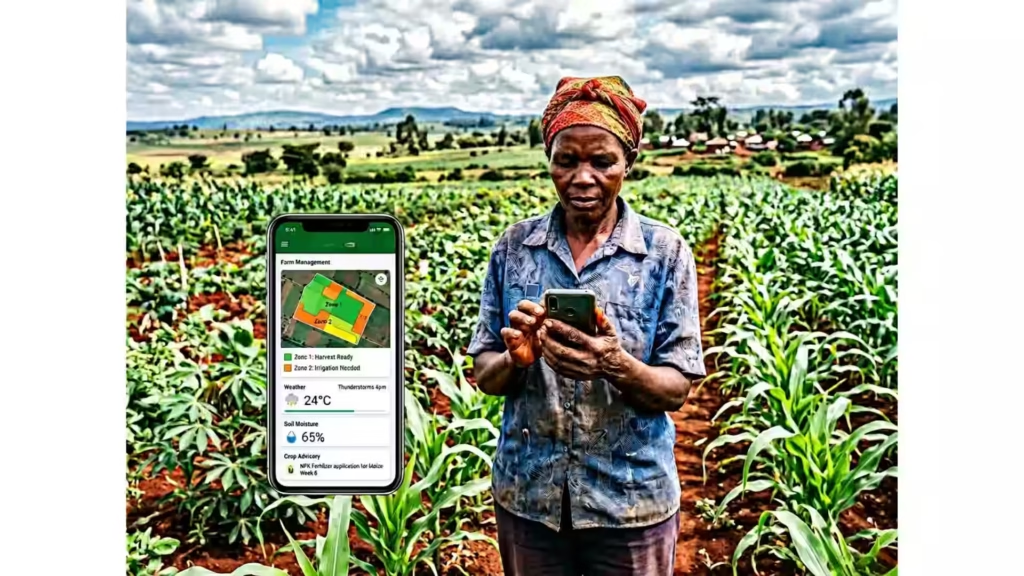
Precision agriculture advisory services provide real-time data to smallholders, de-risking the agricultural supply chain from the soil up. Image: AI generated for illustration
Satellite Technology and Remote Sensing at Farmer Scale
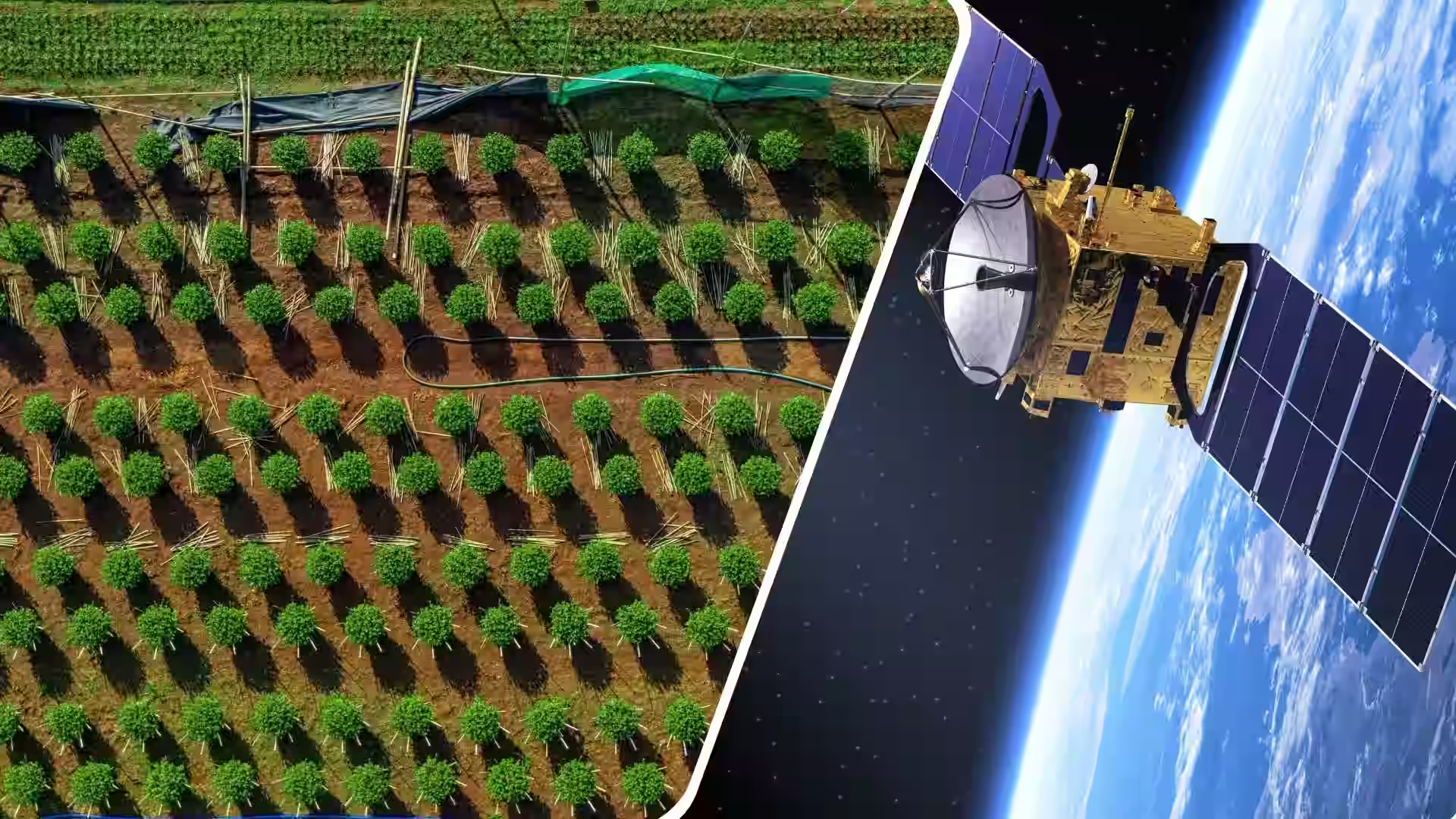
The democratisation of satellite imagery has been one of the most consequential technology shifts for African agriculture in the past five years. Commercial satellite constellations from Planet Labs, Maxar, and the European Space Agency’s Sentinel programme now produce multispectral imagery of virtually every agricultural area in Africa at resolutions and revisit frequencies that were available only to government agencies and large commercial operators a decade ago.
The practical applications for smallholder precision agriculture are numerous. Normalised Difference Vegetation Index (NDVI) analysis, derived from multispectral satellite imagery, allows agronomists and platform algorithms to identify crop stress, estimate biomass accumulation, flag pest or disease pressure, and project yield outcomes across entire regions at the individual field level. This information, delivered to a farmer’s mobile phone as a simple colour-coded map or an SMS advisory, can guide fertiliser top-dressing decisions, trigger early pest intervention, and inform harvest timing in ways that meaningfully improve yields without requiring the farmer to understand the underlying technology.
Several platforms operating in Africa have built business models around satellite-derived crop intelligence. They use satellite imagery combined with machine learning models trained on local agronomic data to generate customised farm plans that include optimised seed variety selection, fertiliser composition and timing, and planting date recommendations for individual smallholder plots. Some platforms also provide the credit to purchase the recommended inputs, repaid from harvest proceeds, linking agronomic advice directly to the financial mechanism that enables its adoption. This integrated model, data plus advice plus credit, is increasingly the dominant commercial structure for scaled smallholder ag-tech in Africa.
The cost of satellite data access has fallen sharply and continues to fall as constellation capacity expands. Platforms that built their models during the period of higher imagery costs now have significant scale advantages in the training datasets that make their predictive algorithms more accurate, creating a durable competitive moat that new entrants will find difficult to replicate without substantial historical data investment.
AI Soil Analysis and the Nutrient Management Opportunity
Soil nutrient deficiency is the single most important agronomic constraint on smallholder yields across Sub-Saharan Africa. The continent’s soils are, on average, highly variable in nutrient composition, pH, and organic matter content, and the widespread use of uniform blanket fertiliser recommendations that take no account of plot-specific soil conditions results in systematic over-application of some nutrients and under-application of others. The result is both an economic waste and an environmental problem: money spent on fertiliser that does not improve yields, and nitrogen runoff that degrades water quality.
AI-driven soil analysis, combining physical soil sampling with spectroscopic analysis and machine learning models trained on large regional soil databases, is making plot-specific soil nutrition recommendations economically viable at smallholder scale for the first time. The iSDA Soil project, developed by Rothamsted Research in partnership with African soil science institutions, has produced the first continent-wide, high-resolution soil nutrient map of Africa, covering 37 soil properties at 30-metre resolution. This dataset, freely available to developers and researchers, is now being incorporated into commercial ag-tech platforms as the foundational soil intelligence layer on which crop-specific nutrition recommendations are built.
Physical soil sampling, historically the limiting factor in soil-specific recommendations, is being supplemented by near-infrared spectroscopy devices that can analyse soil nutrient composition in the field from dried samples in under a minute, at a fraction of the cost of laboratory analysis. Several African agricultural organisations have deployed these devices through extension worker networks, creating the fieldwork capacity to generate plot-specific soil data at scale. As this data is aggregated across platforms, the accuracy of AI recommendation models improves in a compounding dynamic that benefits the entire ecosystem.
For input companies, the precision fertiliser recommendation market represents a significant commercial opportunity. Products calibrated to specific soil nutrient profiles command premium pricing relative to generic commodity fertilisers, and the digital delivery of recommendations creates a direct channel for input procurement that bypasses traditional and often inefficient agro-dealer distribution networks.
Agricultural Fintech
Turning Data into Credit
The most commercially important innovation in African precision agriculture is not the satellite or the sensor. It is the credit product. The majority of smallholder farmers in Africa are excluded from formal agricultural credit, not because they are bad credit risks in any fundamental sense, but because they lack the collateral, documentation, and credit history that conventional lending systems require. The consequence is that even a farmer who understands and wants to adopt improved inputs and practices cannot finance the upfront cost of doing so.
Agricultural fintech platforms are solving this problem by replacing collateral requirements with farm data. A farmer who has used a digital platform to record planting dates, input applications, agronomic practices, and yield outcomes across multiple seasons has generated a verifiable agricultural track record that can substitute for formal credit history in underwriting models. Combined with satellite yield verification, weather station data, and community-level risk pooling, this data-driven credit assessment allows platforms to lend to farmers who have never previously accessed formal credit at repayment rates that compare favourably with conventional microfinance portfolios.
Apollo Agriculture in Kenya and Kenyan-headquartered Pula Advisors, which focuses on agricultural insurance rather than credit, are two of the most analytically sophisticated operators in this space. Pula has insured over 15 million smallholder farmers across Africa and Asia, using a combination of satellite yield index data and weather station triggers to deliver parametric insurance payouts without the claim assessment costs that make conventional indemnity insurance uneconomical at small policy sizes. The parametric model, which pays out automatically when a measurable trigger (such as rainfall below a defined threshold during the critical growing period) is reached, is the product design breakthrough that makes agricultural risk management viable for USD 200 to USD 500 crop value policies.
For institutional investors, agricultural fintech platforms with proven repayment rates and insurance loss ratios represent a new category of fintech asset that combines financial inclusion impact with commercially attractive unit economics. The portfolio aggregation structures that several platforms are developing, bundling smallholder loan books into instruments suitable for institutional capital markets, are at an early but rapidly maturing stage.
Turn Insight Into Action
We help investors, developers, and institutions move from ideas to bankable, de-risked projects across African markets.
Let’s turn your next investment into a structured success.
Climate Variability as the Accelerant
The investment urgency in climate-smart agriculture is not primarily driven by technology maturation or commercial model innovation. It is driven by the accelerating deterioration of agricultural conditions across the continent that makes adoption of adaptive tools an economic necessity rather than an optional upgrade.
Rainfall variability in key agricultural zones across Sub-Saharan Africa has increased measurably over the past two decades. The onset of the long rains in East Africa has become less predictable, with season start dates shifting by two to three weeks in some locations and total seasonal rainfall declining across parts of the region. In the Sahel, desertification is advancing at rates that are pushing the agricultural frontier southward in Mali, Niger, Burkina Faso, and northern Nigeria. In southern Africa, El Nino-related drought cycles are becoming more severe and more frequent.
The crop-specific consequences are significant. Maize, the dominant staple across Sub-Saharan Africa, is particularly sensitive to heat stress during the critical tasseling period. Temperature increases of 1 to 2 degrees Celsius during flowering have been shown to reduce yields by 10 to 30 percent in the major growing regions. Cocoa is sensitive to moisture stress and is facing projected range contraction in Ghana and Ivory Coast as temperatures rise and rainfall patterns shift. Coffee quality in Kenya’s highland growing regions is being affected by temperature-driven changes in bean development that are beginning to impact the premium specialty coffee premiums that Kenyan farmers depend on.
These dynamics are creating a situation in which climate-adaptive technology is no longer competing with farmer inertia. Farmers who have experienced consecutive poor harvests driven by climate variability are actively seeking information, tools, and practices that reduce their exposure to the risks they can see materialising around them. This shift in farmer receptivity to adoption is one of the most important but least quantified drivers of the accelerating uptake in digital agricultural advisory services across the continent.
The Data Asset and Its Long-Term Value
Beyond the immediate commercial models of credit, insurance, and input sales, the aggregated farm data being generated by precision agriculture platforms in Africa represents an emerging asset class with significant long-term value that is not yet fully reflected in platform valuations.
A dataset covering soil profiles, input use records, planting dates, crop management decisions, yield outcomes, climate exposure, and credit repayment behaviour across millions of smallholder farms constitutes the most granular agricultural intelligence asset ever assembled in Africa. The potential buyers and users of this data, appropriately anonymised and ethically governed, span a broad range: commodity buyers seeking supply chain traceability and sustainability verification, input companies seeking to target product development and distribution toward specific agronomic needs, insurers seeking to price agricultural risk products more accurately, governments seeking to design better agricultural subsidy and extension programmes, and development finance institutions seeking to measure the impact of agricultural investment portfolios.
Platforms that are building this data asset with appropriate data governance frameworks, farmer consent mechanisms, and privacy protections are creating a resource that will generate revenue streams over time that are qualitatively different from and potentially more durable than the transaction revenues from credit and input sales. Investors assessing precision agriculture platform valuations in Africa should be incorporating this data asset value into their frameworks alongside conventional fintech metrics.
Investment Entry Points and Market Structure
The African precision agriculture market is at an early but rapidly consolidating stage. The first generation of platforms, which launched primarily in Kenya, Ghana, Nigeria, and Ethiopia between 2015 and 2020, have now accumulated sufficient operational history, agronomic data, and credit portfolio track records to support institutional capital deployment at meaningful scale.
The most active investors in the sector currently include Acumen, Omidyar Network, the Bill and Melinda Gates Foundation (through its agricultural development programme), the International Finance Corporation, and a growing cohort of climate-focused venture capital funds including Breakthrough Energy Ventures. The emergence of climate-dedicated capital has been particularly significant for precision agriculture platforms, which can now access investment from funders whose primary mandate aligns with the climate adaptation and mitigation outcomes these platforms generate.
For infrastructure and private equity funds looking for entry points, the most accessible opportunities are in platform companies that have moved beyond early-stage proof of concept and are scaling established models across new geographies within Africa. The geographic expansion from the more developed East African markets (Kenya, Rwanda, Tanzania) into the larger but less penetrated West African markets (Nigeria, Ghana, Senegal) is the current growth frontier for the most advanced operators.
This article is part of Energy and the Green Transition series. The full series establishes that Africa’s food economy is at an inflection point, moving from raw commodity export toward value-added industrial production. This briefing focuses on the specific sectors, supply chain gaps, and technology layers where capital deployment can capture that transition. Read the full Agribusiness and Food Security series.
Within this series:
- Smallholder traceability and productivity data are foundational requirements for EUDR compliance and premium cocoa supply chains. Precision ag-tech investment at the farm level is the enabling layer for the cocoa value chain upgrade thesis. → Read From Cocoa to Chocolate: The Industrialization of West African Agribusiness
- Higher smallholder yields, particularly in horticulture and perishable crops, are only commercially valuable if post-harvest cold chain infrastructure exists to move produce to market without spoilage. Ag-tech and cold chain investment are complementary legs of the same agribusiness thesis. → Read Cold Chain Logistics: The USD 50 Billion Opportunity in Africa’s Perishable Markets
Related Articles
- Agricultural fintech is following the same platform consolidation dynamic visible in consumer fintech: standalone credit or insurance products are being absorbed into integrated platforms that combine multiple financial services for the same smallholder customer base. → Read Fintech Consolidation 2026: Why Super-Apps are Dominating Tier-1 Markets in Africa
- The AI models underpinning soil analysis, yield prediction, and credit underwriting in African precision agriculture require substantial data processing infrastructure. Data centre development in Nigeria and Kenya directly enables the next generation of ag-tech analytical capability. → Read The Infrastructure of AI: Nigeria’s First Dedicated Data Centres
Have you Read?
De-risking African Infrastructure Investment
Public-Private Partnerships PPPs: The Future of Infrastructure in Emerging Markets
Turn Insight Into Action
We help investors, developers, and institutions move from ideas to bankable, de-risked projects across African markets.
How We Support You
- Validate opportunities with on-the-ground intelligence
- Structure investments to manage risk and attract capital
- Connect you with trusted partners, financiers, and advisors
- Navigate regulatory, financial, and operational complexity
Why It Matters
Opportunities don’t fail because they lack potential, they fail because they’re not structured to succeed.
Partner with BOH Infrastructure to unlock strategic opportunities in Africa.
Let’s turn your next investment into a structured success.
FAQ: Investing in Precision Ag-Tech for Smallholders
What is precision agriculture and how does it apply to African smallholder farming?
Precision agriculture uses data, satellite imagery, sensors, and analytical software to optimise farming decisions at the individual field level rather than applying uniform practices across an entire farm. For African smallholders, it means receiving customised advice on planting dates, seed variety selection, fertiliser application, and pest management based on real data from their specific plot, delivered via mobile phone, rather than relying on generic recommendations or tradition.
How has satellite technology changed agricultural decision-making for smallholder farmers?
Commercial satellite constellations now produce high-resolution, frequently updated imagery of agricultural land across Africa at costs that make smallholder-scale applications commercially viable. Platforms use this imagery to generate crop health maps, identify stress and disease pressure, estimate yields, and verify farming practices, all without requiring the farmer to purchase or operate any equipment. The data is processed by algorithms and delivered as simple, actionable recommendations to the farmer’s mobile phone.
What is parametric agricultural insurance and why is it suited to smallholder farmers in Africa?
Parametric insurance pays out automatically when a measurable trigger, such as rainfall below a defined threshold during the critical growing season, is reached, without requiring individual farm assessments or claim processing. This removes the cost that makes conventional indemnity insurance uneconomical for small policy sizes. Companies like Pula Advisors have used parametric models to insure millions of smallholder farmers across Africa at premium levels that are affordable relative to crop values.
How are agricultural fintech platforms assessing credit risk for farmers without formal credit histories?
Platforms replace conventional credit scoring with farm data underwriting. A farmer who has used a digital platform to record planting decisions, input applications, and yield outcomes across multiple seasons has generated a verifiable agricultural track record. Combined with satellite yield verification, weather data, and community-level risk indicators, this data allows platforms to underwrite credit for farmers with no formal credit history at repayment rates that compare favourably with conventional microfinance portfolios.
What is climate-smart agriculture and why is it becoming more urgent in Africa?
Climate-smart agriculture specifically designs farming practices and tools to increase productivity, build resilience to climate shocks, and reduce greenhouse gas emissions simultaneously. The urgency in Africa is driven by accelerating climate variability: less predictable rainfall onset, more frequent drought cycles, heat stress on staple crops, and shifting growing season windows are already reducing yields across key agricultural regions and making climate-adaptive tools an economic necessity for farming households.
What role does soil data play in improving smallholder farm productivity?
Soil nutrient deficiency is the most important single constraint on smallholder yields across Sub-Saharan Africa. Uniform fertiliser recommendations that ignore plot-specific soil conditions result in systematic misapplication of nutrients. AI-driven soil analysis, combining physical sampling with spectroscopic analysis and machine learning models, enables customised fertiliser recommendations for individual plots that improve yields while reducing input waste and environmental runoff.
What types of investors are active in African precision agriculture and ag-tech platforms?
The investor base spans impact-focused venture capital (Acumen, Omidyar Network), development finance institutions (IFC, British International Investment), climate-dedicated funds (Breakthrough Energy Ventures), and agricultural development foundations (Bill and Melinda Gates Foundation). As platforms mature and build multi-season operational track records, private equity funds with African consumer and financial services portfolios are beginning to enter at later growth stages, and institutional capital markets investors are evaluating the portfolio aggregation structures being developed for smallholder loan books.
Share this post:
Know someone who needs to see this? Share it with them!
Ready to explore opportunities in one of Africa’s fastest-growing markets?
Investment
Opportunities in
Africa in 2026
We provide expert guidance on market entry, due diligence, and business development support.