
Ghost Projects and How to Avoid Them
AI Monitoring, Satellite Oversight, and the BOH Quality Assurance Process
KEY TAKEAWAYS
- Ghost projects are a preventable failure mode, not an unavoidable feature of African infrastructure investment.
- The distinguishing characteristic of ghost projects is not that they faced insurmountable obstacles. It is that emerging problems were either not detected or not acted upon before they became irreversible.
- The monitoring gap is the specific vulnerability that technology solves. Conventional oversight relies on periodic site visits and contractor-provided documentation that creates intervals during which project conditions can deteriorate without detection.
- The most expensive quality failures in African infrastructure occur at the feasibility stage, not during construction. A project built on faulty demand assumptions or technically inappropriate design is compromised at conception.
- Satellite monitoring provides independent verification that fundamentally changes contractor incentive structures. A contractor who knows that its self-reported progress will be cross-checked against independent satellite imagery before disbursement is approved faces a different incentive structure from one whose reporting is accepted on the basis of documentation alone.
- The cost of integrated technical oversight is consistently smaller than the cost of a single project failure. At 1 to 2% of total project cost, a comprehensive technical de-risking programme costs less than the interest on a six-month construction delay for a typical mid-scale African infrastructure project.
DEFINITION
What Is a Ghost Project in African Infrastructure?
A ghost project is an infrastructure transaction that progresses through some or all of the formal stages of project development, including feasibility, financing, and sometimes construction commencement, but fails to reach commercial operation or delivers infrastructure that is substantially incomplete, non-functional, or so far removed from its original specifications that it cannot fulfil the purpose for which it was financed.
The term captures a broader spectrum of project failure than simple construction default. At one end of the spectrum are projects that reach financial close, draw down their construction financing, and then essentially disappear: funds are disbursed, contractor invoices are paid, but physical progress on site bears no relationship to the financial drawdown. At the other end are projects that are physically completed but at such variance from their original technical specifications, or with such poor construction quality, that they cannot be commissioned, certified, or operated safely. Between these extremes lies a wide range of partial failures: projects that are completed years late and far over budget, leaving debt service obligations that the project’s revenue cannot support; projects that are operational but chronically underperforming due to construction defects or design errors; and projects that operate for a period before catastrophic failure due to inadequate maintenance infrastructure.
Ghost projects in Africa arise from a combination of factors that are individually manageable but collectively dangerous when they occur together. Inadequate pre-feasibility analysis creates projects that are misconceived from the beginning, built on demand projections that were never realistic or technical assumptions that were never verified. Weak construction oversight allows contractor fraud, substandard materials, and undisclosed subcontracting to go undetected until the consequences become irreversible. Poor project management allows schedule and cost variances to compound over time without triggering corrective action. And the absence of independent verification of construction progress allows disbursement to continue against work that has not been done.
The defining characteristic of a ghost project is not that it failed. All investments carry the risk of failure. The defining characteristic is that it failed in ways that were foreseeable, detectable, and preventable with appropriate technical oversight from the earliest stages of development.
Ghost Projects and How to Avoid Them: AI Monitoring, Satellite Oversight, and the BOH Quality Assurance Process
This article is in BOH Infrastructure’s 2026 Sovereign Risk Outlook series. The full Outlook establishes that risk in Africa is overwhelmingly a perception problem rather than a structural one. This briefing addresses the dimension of risk where perception and reality most frequently diverge: the technical and operational execution of infrastructure projects from feasibility to commercial operation.
The Right Strategy
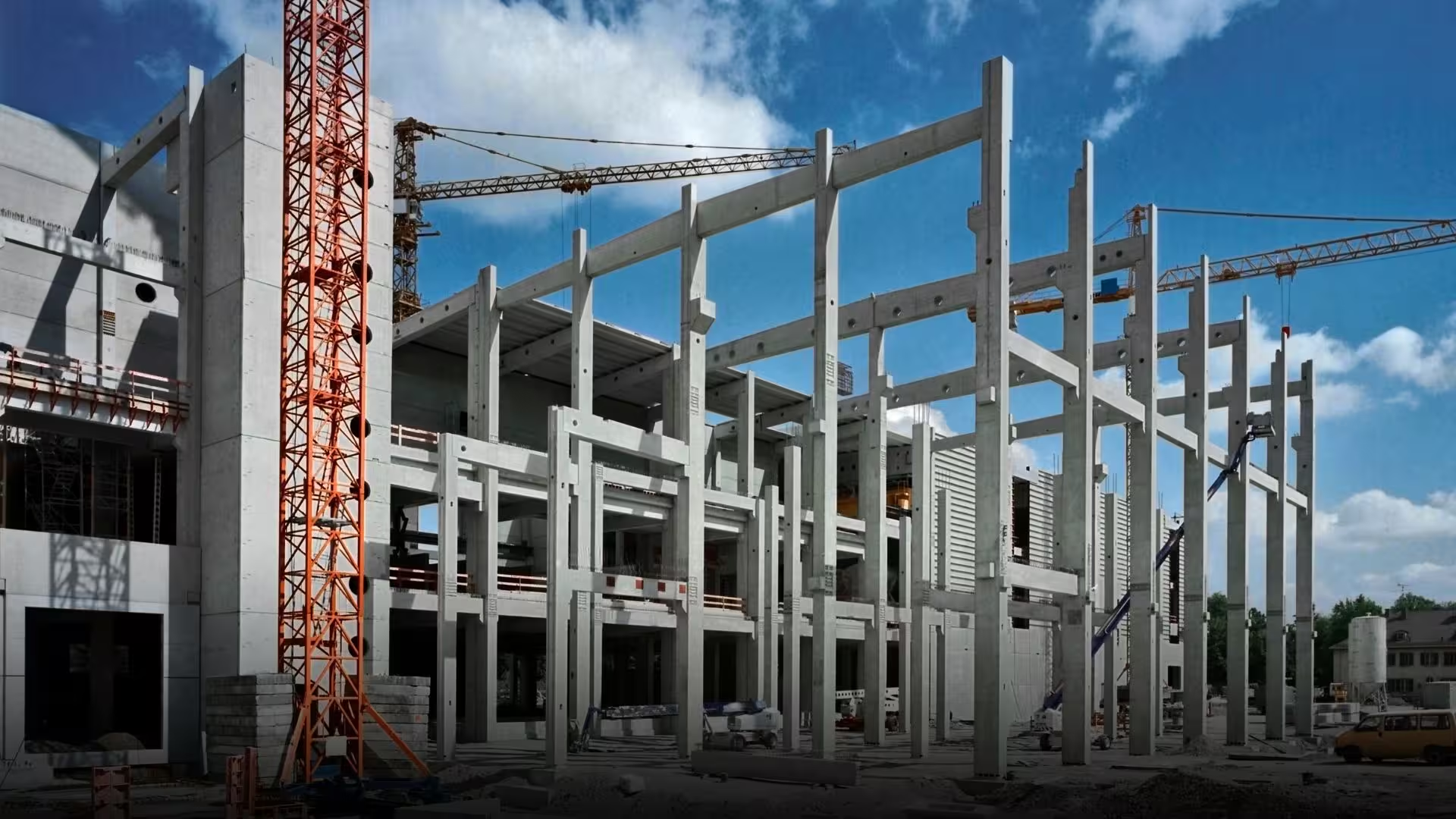
Africa’s infrastructure pipeline looks impressive on paper. Across the continent, feasibility studies are commissioned, environmental assessments are completed, financial models are built, and financing term sheets are signed. Project groundbreaking ceremonies are held, often with ministers, ambassadors, and cameras present. And then, with troubling frequency, the project stalls. Construction slows to a crawl, milestones are missed, funds are diverted, and what began as a nationally significant infrastructure investment becomes what practitioners call a ghost project: a transaction that reached financial close but never reached commercial operation.
Ghost projects are not a uniquely African phenomenon. Construction delays, cost overruns, and project failures occur in every infrastructure market in the world. But in Africa, the consequences are particularly severe. Capital is scarcer, lender appetite is thinner, government budgets are more constrained, and the communities that infrastructure projects are meant to serve have fewer alternative options. A ghost project in an African market does not merely destroy investor returns. It sets back the infrastructure development agenda of an entire country, damages the sovereign’s reputation with international capital markets, and makes the next generation of projects harder and more expensive to finance.
This briefing addresses the operational and technical dimension of African infrastructure risk: the risk that a project which is financially structured and legally protected still fails to deliver because of inadequate construction oversight, poor project management, systemic leakage of project funds, and the absence of rigorous quality assurance from the earliest stages of project development.
BOH Infrastructure’s approach to technical and operational de-risking integrates three categories of solution. Artificial intelligence driven project management tools provide real-time visibility into construction progress, cost trajectories, and schedule adherence across complex, geographically dispersed project sites. Satellite monitoring and remote sensing technology enables independent verification of physical construction progress, environmental compliance, and site conditions without dependence on contractor self-reporting. The BOH Quality Assurance process, applied from pre-feasibility through to commercial operation, provides the human expertise, institutional relationships, and analytical rigour that technology alone cannot supply.
Together, these three elements form a technical de-risking framework that changes the probability distribution of project outcomes, reducing the likelihood of the catastrophic failure scenarios that haunt infrastructure investors and dramatically improving the predictability of returns across the project lifecycle.
In 2018, the African Development Bank published an analysis of infrastructure project completion rates across its portfolio. The findings were sobering. A substantial proportion of projects financed by the Bank experienced significant cost overruns, with average actual costs exceeding appraisal estimates by margins that, in some sectors, exceeded 50%. Schedule delays were even more prevalent, with the average time from project approval to completion running materially longer than original projections in every infrastructure sector reviewed.
The AfDB is not an unsophisticated lender. It applies rigorous appraisal standards, requires detailed feasibility documentation, and maintains resident representatives in its member countries. If project execution failures occur at this scale in an AfDB-financed portfolio, the scale of failure in the broader universe of African infrastructure transactions, including those financed without multilateral oversight, is considerably larger.
The money lost to ghost projects and partial project failures in Africa is not lost to the continent’s fundamentally poor investment prospects. It is lost to preventable execution failures: contractors whose self-reported progress bore no relationship to physical reality, cost overruns that accelerated for months before anyone with authority to intervene was aware of them, and construction defects that were invisible to periodic site visits but would have been obvious to continuous monitoring.
This is the problem that technical and operational de-risking addresses. And the tools available to address it have never been more powerful.Main article into and separation lines
The Anatomy of Project Failure in African Infrastructure
Why Good Projects Become Ghost Projects
Understanding how to prevent ghost projects requires understanding precisely how and why they occur. The failure modes are, in most cases, recognisable and repetitive. They fall into three broad categories.
The first is misconception at the design stage. A project that is built on faulty assumptions at the feasibility stage is compromised before ground is broken. Demand projections that are not grounded in rigorous market analysis, technical assessments that rely on secondary data rather than site-specific investigation, financial models built on cost estimates that have never been benchmarked against comparable completed projects in the region: each of these creates a foundation that will crack under the weight of actual project execution. The most common form of this failure is the optimism bias that affects almost every large infrastructure project globally, but that is particularly acute in markets where comparable data is scarce and where sponsors have strong incentives to present projects as viable regardless of the underlying evidence.
The second failure mode is contractor management. Construction in Africa frequently involves complex contracting chains in which international engineering procurement and construction firms subcontract significant portions of the work to local or regional contractors whose capacity, financial strength, and quality management systems have not been adequately assessed. The international firm provides the credentials and the bid capacity. The local subcontractor provides the actual construction workforce and management. When the subcontractor lacks the systems to deliver to specification, or when the principal contractor lacks the site management capacity to oversee dispersed operations across difficult terrain, quality and schedule failures accumulate faster than any periodic monitoring process can detect.
The third failure mode is financial leakage. In its most straightforward form, leakage involves fraudulent invoicing for work that has not been done or materials that have not been delivered. In more sophisticated forms, it involves related-party transactions that divert project funds to entities connected to project sponsors or contractors, front-loaded contract structures that allow contractors to extract profit early in the project lifecycle and then abandon the project when margins are exhausted, and disbursement mechanisms that release funds against paperwork rather than verified physical progress. Financial leakage is particularly difficult to detect through conventional oversight mechanisms because it is designed to be invisible to precisely those mechanisms.
The Monitoring Gap
The fundamental problem with conventional construction oversight in remote or difficult-access African environments is the monitoring gap: the interval between site visits, audits, or progress reports during which project conditions can deteriorate without any responsible party being aware.
A quarterly site visit by a lender’s technical adviser captures a snapshot of site conditions at four points in a year. In the intervals between those snapshots, substandard materials can be incorporated, structural elements can be omitted, and financial leakage can compound. By the time the next site visit reveals a problem, months of compounding deviation have occurred and corrective action has become substantially more expensive, if it remains possible at all.
The monitoring gap is not a consequence of negligence. It is a consequence of the cost and logistical difficulty of maintaining continuous physical presence at infrastructure project sites in remote African locations, combined with the limited capacity of many project company management teams to maintain rigorous internal monitoring systems while simultaneously managing the complex operational demands of active construction.
The technology solutions described in the next two sections of this briefing exist to close the monitoring gap. They do not replace human expertise and judgment. But they extend the reach of that expertise continuously, across geography and time, in ways that periodic physical oversight cannot match.
Instrument 1: AI-Driven Project Management
What AI Project Management Means in the Infrastructure Context
Artificial intelligence driven project management in infrastructure does not refer to autonomous systems making decisions about how projects should be built or managed. It refers to the application of machine learning, predictive analytics, and automated data processing to the information generated by complex construction projects, in order to identify variances, predict risks, and surface issues requiring human attention faster and more reliably than conventional manual monitoring systems can achieve.
The volume of data generated by a large infrastructure project during construction is enormous: contractor progress reports, materials delivery records, workforce attendance logs, equipment utilisation data, weather records, financial drawdown information, quality inspection records, and environmental compliance documentation, among others. A human project management team reviewing this data through conventional means can process only a fraction of it in real time. Patterns that would indicate emerging problems, a gradual deceleration in concrete pours relative to the schedule, a systematic discrepancy between reported and actual equipment utilisation, an unusual concentration of cost variances in a specific work package, are invisible in the noise of daily project operations until they have become serious enough to be unmistakable.
AI systems trained on historical project data from comparable infrastructure projects can identify these patterns at their earliest emergence, flagging anomalies for human review before they become irreversible problems. This is the core value proposition: not superior decision-making but superior pattern recognition, applied continuously across the full dataset of a complex project.
Specific Applications in African Infrastructure Projects
Schedule performance analysis is one of the most immediately valuable AI applications in African construction oversight. By integrating contractor progress reports with historical performance data from comparable projects, AI systems can generate probabilistic forecasts of completion dates and identify the specific work packages most likely to drive schedule overruns. This allows project managers and lenders’ technical advisers to concentrate oversight resources on the areas of greatest schedule risk rather than distributing attention uniformly across the project.
Cost trajectory analysis performs a similar function for financial management. By comparing actual cost performance against the project’s cost plan on a continuous basis, and by applying predictive models to identify cost variance trends before they become material overruns, AI systems can trigger early warning alerts that allow corrective action while the project still has financial capacity to respond. In a conventional oversight model, cost overruns frequently become visible to lenders only through quarterly financial reports, by which point the variance has often already exceeded the project’s contingency reserve.
Contractor performance monitoring uses AI analysis of project data to build performance profiles for individual contractors and subcontractors, tracking metrics including schedule adherence, quality inspection outcomes, materials management efficiency, and workforce productivity. Over time, these profiles generate early warning signals when contractor performance begins to deteriorate below acceptable thresholds, enabling intervention before the deterioration becomes entrenched.
Document analysis and anomaly detection applies natural language processing to the large volumes of contractual documentation, invoices, delivery notes, and correspondence generated by infrastructure projects, flagging anomalies that may indicate fraudulent invoicing, unauthorised subcontracting, or non-compliant procurement processes. This application is particularly valuable for addressing the financial leakage failure mode described above, where fraud is specifically designed to evade document-level review.
Integration with Project Finance Structures
AI project management tools are most valuable when they are integrated into the project’s financial structure rather than operated as a standalone monitoring service. This means connecting the AI system’s outputs directly to the project’s disbursement mechanism, so that financial drawdowns against construction progress are verified against AI-generated progress assessments rather than solely against contractor self-certification.
BOH Infrastructure designs disbursement verification protocols that use AI-generated progress data as one of the mandatory inputs for drawdown approval. A contractor claiming payment for 60% completion of a specific work package must be able to demonstrate progress consistent with that claim not only through its own documentation but through the independent AI assessment of site data. Where the AI assessment diverges materially from the contractor’s self-report, the variance triggers a mandatory independent site inspection before the drawdown is approved.
This integration changes the incentive structure for contractors in ways that conventional oversight cannot. When contractors know that their progress reports will be cross-checked against independent AI analysis before payment is released, the incentive for fraudulent progress reporting is substantially reduced. The monitoring tool does not merely detect fraud. It deters it.
Instrument 2: Satellite Monitoring and Remote Sensing
The Technology and Its Capabilities
Satellite monitoring for infrastructure construction has advanced dramatically over the past decade, driven by the proliferation of commercial earth observation satellites that now provide coverage of virtually any point on the African continent at resolutions sufficient to monitor construction progress in meaningful detail.
Modern commercial satellite imagery can resolve features as small as 30 centimetres at nadir, sufficient to identify individual structural elements, equipment positions, material stockpiles, and workforce concentrations on a construction site. Synthetic aperture radar imagery, which penetrates cloud cover and operates in all weather and lighting conditions, provides continuous monitoring capability in the equatorial African environments where persistent cloud cover can make optical imagery unreliable. Multispectral imagery enables analysis of vegetation health, soil disturbance, and surface water changes relevant to environmental compliance monitoring. And the revisit frequency of commercial satellite constellations has improved to the point where daily or even multiple-daily imagery coverage is available for high-priority sites.
The implications for infrastructure construction monitoring are significant. For the first time in the history of African infrastructure development, it is possible to maintain continuous, independent, tamper-proof verification of physical construction progress at any site on the continent, regardless of its accessibility, at a cost that is a small fraction of the value of the projects being monitored.
What Satellite Monitoring Can Verify
Physical construction progress verification is the most direct application. By comparing sequential satellite imagery of a construction site against the project’s construction schedule, it is possible to independently verify whether physical progress is consistent with contractor reporting. A contractor claiming 40% structural completion of a bridge pier can be assessed against imagery showing the actual height of the pier structure. A road construction contractor claiming completion of 60 kilometres of earthworks can be verified against imagery showing the actual extent of ground disturbance and formation grading.
This verification capability is particularly powerful for the financial leakage failure mode. Ghost billing, the fraudulent invoicing of work that has not been done, is one of the most common forms of project fraud in African infrastructure. Satellite imagery provides an independent record of actual physical progress at any point in time, against which claimed progress can be verified. It is not infallible, but it closes the monitoring gap to the point where systematic ghost billing becomes extremely difficult to sustain without detection.
Material delivery and stockpile monitoring uses satellite imagery to track the arrival, storage, and consumption of bulk construction materials on site. Discrepancies between reported material deliveries and observed stockpile levels can indicate diversion of materials, fraudulent delivery documentation, or supplier fraud. In remote sites where physical inspection of delivery documentation is logistically difficult, satellite monitoring provides a practical alternative verification mechanism.
Environmental compliance monitoring uses multispectral imagery to track vegetation clearance, soil erosion, sediment runoff, and surface water contamination in the construction zone. Many African infrastructure projects have environmental compliance obligations as conditions of their financing from development finance institutions, and violations can trigger disbursement suspension or, in severe cases, financial penalties. Continuous satellite monitoring of the construction zone provides early warning of environmental compliance issues before they escalate to the point of triggering lender action.
Site safety and workforce monitoring uses optical imagery to assess workforce density and equipment utilisation patterns on site, providing a cross-check on labour cost reporting and an indicator of overall site productivity. A site reporting full workforce deployment but showing minimal activity in satellite imagery is a signal requiring immediate investigation.
Limitations and the Human Factor
Satellite monitoring is a powerful tool but it has limitations that must be understood to deploy it effectively. High resolution commercial imagery is expensive, and continuous monitoring of multiple sites across a large project portfolio requires careful cost management. Image interpretation requires trained analysts who can distinguish meaningful anomalies from normal construction variation: not every discrepancy between satellite observation and contractor reporting indicates fraud or failure. And satellite imagery cannot assess quality below the surface: it can verify that a concrete structure has been built to the correct dimensions but cannot assess whether the concrete mix met specification or whether the reinforcement was correctly placed.
These limitations are not arguments against satellite monitoring. They are arguments for integrating satellite monitoring into a broader technical oversight framework that combines remote sensing with AI-driven data analysis, periodic physical site inspections by qualified engineers, and the BOH Quality Assurance process described in the following section. Each tool in the framework addresses the blind spots of the others. Together, they provide a level of continuous, independent oversight that no single monitoring method can achieve alone.
Instrument 3: The BOH Quality Assurance Process
Quality Assurance as a Development Discipline, Not a Construction Checklist
In conventional infrastructure project management, quality assurance refers to the processes and systems applied during construction to ensure that work meets the technical specifications defined in the engineering design. It involves inspection protocols, material testing, dimensional verification, and documentation of construction activities against an agreed quality plan.
BOH Infrastructure’s Quality Assurance process begins at this conventional understanding but extends it in two important directions. First, it extends backwards in time to the pre-feasibility and feasibility stages of project development, where the most consequential quality failures in African infrastructure occur. Second, it extends the definition of quality beyond technical specification compliance to encompass the economic, regulatory, and institutional conditions that determine whether a project will be viable in operation, not just built to specification.
The BOH QA process is based on a single organising principle: the most expensive quality failure in any infrastructure project is the failure that is not discovered until it is irreversible. A design error identified during pre-feasibility costs relatively little to correct. The same error identified during detailed engineering costs more. Identified during construction, it costs significantly more still, often triggering change orders, schedule delays, and lender disputes. Identified after commissioning, it can make a project non-operational without a complete rebuild. The economics of quality assurance are overwhelmingly front-loaded.
The Pre-Feasibility Gate Review
The BOH Quality Assurance process begins with what the firm calls a Pre-Feasibility Gate Review: a structured technical, economic, and institutional assessment of a project concept conducted before any significant development expenditure is committed. The Gate Review is designed to answer three questions that are frequently not rigorously addressed in conventional feasibility analysis.
The first question is whether the project’s demand assumptions are grounded in verifiable evidence. African infrastructure feasibility studies frequently rely on top-down demand projections derived from national statistics and regional comparators rather than bottom-up analysis of actual willingness and ability to pay in the specific market the project will serve. A power project whose financial model assumes industrial demand that has not been verified through direct engagement with potential industrial customers, or a toll road whose traffic projections are derived from national vehicle registration statistics rather than origin-destination surveys, is built on assumptions that will not survive contact with commercial operation. The Gate Review requires primary evidence for all material demand assumptions before the project advances to detailed feasibility.
The second question is whether the technical concept is appropriate for the specific site conditions, supply chain environment, and operational context of the host market. Technologies that perform reliably in European or North American infrastructure contexts may perform differently in African environments characterised by extreme temperatures, limited maintenance supply chains, intermittent grid power for auxiliary systems, or challenging geological conditions. The Gate Review requires site-specific technical assessment, including geotechnical investigation where relevant, and benchmarking of the proposed technology against comparable deployments in comparable African environments.
The third question is whether the institutional context, the government counterparty’s capacity to fulfil its contractual obligations, the regulatory framework’s fitness for purpose, and the local labour and contractor market’s ability to support construction and operation, is adequate to support the project as designed. Projects that are technically sound but institutionally mismatched to their host environment fail not because of engineering deficiency but because the human and institutional systems required to build and operate them do not exist at the required standard. The Gate Review assesses institutional fit as rigorously as technical fit.
The Commissioning and Ramp-Up Assessment
One of the most frequently overlooked phases of African infrastructure project quality assurance is the period between physical construction completion and stable commercial operation. This transition period, which in complex infrastructure projects can span six to eighteen months, is characterised by the handover from construction contractor to operations team, the resolution of defects identified during testing and commissioning, the ramp-up of revenue to projected steady-state levels, and the establishment of the operational management systems that will govern the project for its full commercial life.
Ghost projects that survive the construction phase and reach physical completion frequently encounter their most serious problems during this transition. Operations teams that have not been hired, trained, or resourced in advance of commissioning cannot take over effectively from the construction contractor. Defects that the contractor has an obligation to rectify under the defects liability period are not identified and recorded systematically, allowing the defect liability period to expire without full remediation. Revenue ramp-up trajectories that were modelled in the financial projections but never operationally planned for fall short of projections in ways that create immediate debt service pressure.
The BOH Commissioning and Ramp-Up Assessment provides structured support through this critical transition phase, combining a systematic defect recording and remediation tracking system, an operational readiness review that assesses whether the operations team, maintenance systems, spare parts inventory, and management information systems are in place before physical handover, and a revenue ramp-up monitoring programme that tracks actual revenue against the financial model’s projections and identifies corrective actions where performance is below trajectory.
Have you read?
- Beyond the Devaluation Fear: How Indexed Tariffs, Currency Sweeps, and Offshore Escrow Protect Your African Infrastructure Returns
- From B-Rated to Bankable: A Technical Guide to PRGs, MIGA Guarantees, and Blended Finance in African Infrastructure
- Protecting Against the Stroke of a Pen: Stabilization Clauses, International Arbitration, and Regulatory Sandboxes in African PPPs
Putting It Together: The Integrated Technical De-risking Framework
Why Integration Matters
The three instruments described in this briefing, AI project management, satellite monitoring, and the BOH Quality Assurance process, are each individually valuable. But their combined effect on project outcomes is greater than the sum of their individual contributions, because they address different failure modes and different time horizons in a complementary rather than overlapping way.
A project that is protected by this integrated framework has a fundamentally different risk profile from one that relies on conventional periodic oversight. The probability distribution of its outcomes, the range of scenarios from catastrophic failure to smooth delivery within budget and on schedule, is narrowed substantially at the tail. Ghost project scenarios, which are tail events, become extremely unlikely rather than merely unfortunate.
The Lender Perspective
For lenders and development finance institutions, the integrated technical de-risking framework addresses a specific and long-standing problem in African infrastructure financing: the difficulty of maintaining adequate visibility into project execution between periodic financial reporting periods, particularly in remote or difficult-access locations.
Most lender technical adviser mandates in African infrastructure are structured around periodic site visits and review of contractor-provided documentation. This structure is adequate for projects in accessible locations with reliable contractors whose progress reporting is accurate and complete. It is inadequate for projects in remote locations, with complex subcontracting chains, in markets where institutional quality management systems are underdeveloped.
BOH’s integrated framework closes this gap by providing lenders with continuous, independently verified project performance data between periodic reporting intervals. Lenders participating in BOH-advised transactions have access to the monthly Technical Report and the satellite monitoring data as a standard component of their information rights package. This continuous information flow allows lenders to identify emerging problems and take corrective action at a point when intervention is still effective, rather than discovering problems after they have become irreversible.
For development finance institutions applying their own environmental and social safeguards standards, the satellite monitoring component of the framework provides continuous independent verification of environmental compliance, which is increasingly a requirement of their disbursement conditions.
The Cost of Not Monitoring
Quantifying the Value of Prevention
The cost of implementing the integrated technical de-risking framework described in this briefing is measurable. For a mid-scale African infrastructure project with a total construction cost of USD 100 to 200 million, the combined cost of AI project management tools, satellite monitoring, and the BOH Quality Assurance programme over the construction period typically represents 1 to 2% of total project cost.
The cost of not monitoring is also measurable, though the data is not always published. Published analyses of infrastructure project cost overruns in Africa consistently find average cost overruns in the range of 20 to 40% of original estimates for projects without robust independent oversight, with schedule overruns running to months or years beyond original completion dates. At a project cost of USD 150 million, a 30% cost overrun represents USD 45 million of additional capital requirement, against which the cost of 2% for integrated monitoring is trivially small.
The more important comparison, however, is the avoided loss from ghost project scenarios. A project that reaches financial close, draws down its construction financing, and then fails to reach commercial operation does not merely lose the monitoring cost. It loses the entire invested capital. For a lender, this means writing off a loan that may represent 60 to 70% of total project cost. For an equity investor, it means the total loss of the equity contribution. For the host government, it means a national infrastructure asset that does not exist, a sovereign debt obligation that must still be serviced, and a damaged relationship with international capital markets that makes the next project more expensive.
The prevention of a single ghost project scenario pays for an entire portfolio-level monitoring programme many times over.
Conclusion
Ghost projects are not a mystery. They are the predictable consequence of inadequate technical oversight applied to complex construction activities in challenging environments. The failure modes are known. The points in the project lifecycle at which they occur are known. The tools for detecting and preventing them are available, proven, and increasingly affordable.
What has been missing, in too many African infrastructure transactions, is the discipline to apply those tools from the beginning of the project development process rather than deploying oversight resources reactively after problems have become visible. A lender who requires satellite monitoring only after a quarterly site visit reveals unexplained cost variances is closing the stable door after the horse has left. The monitoring framework needs to be in place before the first contract is awarded and before the first disbursement is made.
BOH Infrastructure’s integrated approach to technical and operational de-risking is built on a simple conviction: the projects that deliver their intended returns to investors and their intended services to communities are not the ones that got lucky with good contractors in benign environments. They are the ones that were designed correctly from the beginning, monitored continuously throughout construction, and managed through commissioning with the same rigour applied to their financial close. Technical excellence is not a soft goal for development impact reporting. It is the foundation on which financial returns are built.
The continent does not need fewer infrastructure projects. It needs more infrastructure projects that actually get built, commissioned, and operated to the standard on which their financial models were based. That is what rigorous technical de-risking delivers.
This article is part of BOH Infrastructure’s 2026 Sovereign Risk Outlook. The anchor report establishes why African infrastructure risk is a perception problem and introduces the full BOH de-risking framework across all four risk dimensions. → Read the full 2026 Sovereign Risk Outlook.
Currency de-risking is Cluster 1 in this series. For a practical guide to Currency Sweeps, Indexed Tariffs, and Offshore Escrow for African infrastructure transactions. → Read Beyond the Devaluation Fear.
Currency structuring is one pillar of bankability. The second is credit enhancement. Read our full briefing on how MIGA guarantees, AfDB instruments, and blended finance make a B-rated project look like an A-rated investment. → From B-Rated to Bankable: A Technical Guide to PRGs and Blended Finance
Legal and regulatory de-risking is Cluster 3 in this series. For a guide to Stabilisation Clauses, International Arbitration, and Regulatory Sandboxes in African PPPs. → Read: Protecting Against the Stroke of a Pen.
De-Risk Your African Investment Strategy
Build Smarter. Invest Stronger. Scale Confidently.
Concerned about regulatory shifts, currency volatility, or execution risk in African markets? You’re not alone, and you’re not without options.
At BOH Infrastructure, we specialize in de-risking investments across Africa’s infrastructure and resource sectors. Our approach goes beyond opportunity sourcing. We focus on structuring transactions that are resilient from day one.
Whether you’re entering a new market or scaling an existing portfolio, we provide end-to-end support designed to protect capital and enhance long-term returns.
Why It Matters
The most successful investors in Africa don’t avoid risk, they structure for it.
With the right framework in place, volatility becomes manageable, and opportunity becomes scalable.
Partner with BOH Infrastructure to transform uncertainty into a structured, bankable investment strategy.
FAQ: Title
What exactly is a ghost project and how common are they in African infrastructure?
A ghost project is an infrastructure transaction that progresses through some or all of the formal stages of development and financing but fails to reach functional commercial operation. The spectrum ranges from projects that draw down financing against work that is never done, to projects that are physically built but so far below specification that they cannot be commissioned or operated safely. Systematic data on ghost project prevalence in Africa is difficult to compile because failed projects are not reported consistently, and because the line between a severely delayed or underperforming project and a ghost project is not always clear. However, published analyses by the African Development Bank, the World Bank, and independent researchers consistently find that a substantial proportion of African infrastructure projects experience cost overruns exceeding 20%, schedule delays exceeding one year, and in a meaningful minority of cases fail to reach commercial operation at all. The scale of the problem is significant enough that addressing execution risk is a first-order priority for any serious African infrastructure investor.
How does AI project management differ from conventional project management software?
Conventional project management software, including widely used tools across the industry, requires manual data entry and produces reports that reflect the information project managers choose to input. It is a documentation and reporting tool. AI project management systems differ in two important respects. First, they integrate data from multiple independent sources, including financial systems, sensor networks, satellite imagery, weather stations, and equipment telemetry, creating a picture of project status that does not depend solely on manual input by the project team. Second, they apply machine learning models trained on historical project data to identify patterns in this multi-source dataset that indicate emerging problems, generating alerts for human review rather than requiring analysts to identify anomalies manually. The core value is pattern recognition applied continuously to a larger dataset than any human team can review, producing early warning signals at a point when intervention is still effective rather than after variances have become visible in quarterly reports.
What resolution does satellite monitoring provide and is it sufficient to verify construction quality?
Commercial satellite imagery used for infrastructure monitoring typically provides ground resolution in the range of 30 to 50 centimetres for optical imagery and somewhat coarser resolution for synthetic aperture radar. This resolution is sufficient to verify the physical dimensions of structures, the extent of earthworks and ground disturbance, the presence and approximate quantity of material stockpiles, equipment deployment on site, and workforce concentrations. It is not sufficient to assess subsurface construction quality, concrete mix specifications, reinforcement placement, weld quality, or other aspects of workmanship that require physical inspection and materials testing. Satellite monitoring is therefore most powerful as a complement to physical inspection rather than a substitute for it. It provides continuous verification of what is visible at the surface, which closes the monitoring gap for the most common forms of progress misreporting and financial leakage, while periodic physical inspection by qualified engineers addresses the quality dimensions that remote sensing cannot reach.
At what stage of project development should the BOH Quality Assurance process begin?
The BOH Quality Assurance process begins at pre-feasibility, which is the stage at which the most consequential quality failures in African infrastructure are made and the stage at which they are least expensive to correct. The Pre-Feasibility Gate Review is conducted before any significant development expenditure is committed, typically before detailed feasibility studies are commissioned. This allows the Gate Review findings to inform the scope and methodology of the feasibility work rather than reviewing a feasibility study that has already embedded flawed assumptions. For projects where BOH is engaged after the pre-feasibility stage, the Quality Assurance process begins with a retrospective assessment of the existing feasibility work, identifying assumptions and methodologies that require verification or strengthening before the project advances to financing. The objective in either case is to ensure that the project enters the financing stage with technical foundations that can withstand rigorous lender due diligence and that will not produce surprises during construction.
How does satellite monitoring address environmental compliance obligations in African infrastructure projects?
Many African infrastructure projects financed by development finance institutions are subject to environmental and social standards that require monitoring of vegetation clearance, soil erosion, sediment runoff, and the condition of watercourses and sensitive habitats in and around the construction zone. Conventional environmental compliance monitoring relies on periodic inspections by environmental specialists, which creates the same monitoring gap problem that affects construction progress oversight. Satellite multispectral imagery provides continuous monitoring of the construction zone’s environmental condition, detecting vegetation loss, surface water changes, and soil disturbance in near real-time. This continuous coverage allows environmental compliance issues to be identified at their early stages, before they have caused significant impact and before they have escalated to the point of triggering lender disbursement suspension or regulatory action by the host country’s environmental authority. For projects where environmental compliance conditions are a significant component of the DFI financing package, satellite environmental monitoring has become an increasingly standard component of the compliance management system.
How does the BOH integrated framework affect the project’s relationship with its lenders?
The integrated technical de-risking framework fundamentally changes the information relationship between the project and its lenders. In a conventional African infrastructure financing, lenders receive quarterly financial reports and the results of periodic technical adviser site visits. Between these reporting intervals, their visibility into project conditions is limited to whatever information the project company’s management chooses to communicate. This information asymmetry is a significant source of tension in project finance relationships, particularly when problems emerge and lenders must determine how long the issues have existed and whether management has been managing them or concealing them. The BOH integrated framework provides lenders with continuous access to independently generated project performance data, eliminating the information asymmetry and making the lender-project relationship considerably more collaborative and less adversarial. Lenders who can see project performance in real time are better able to provide constructive support to management when problems emerge, rather than discovering problems after the fact and having to decide whether to enforce their rights under the financing documents.
Can the BOH technical de-risking framework be applied to projects that are already under construction?
Yes, though the scope and cost of implementation depends on the project’s construction stage and the quality of existing monitoring systems. For projects in the early stages of construction where the foundation works and structural elements are not yet substantially advanced, the full BOH framework can be implemented without significant disruption to the existing project management structure. For projects where construction is more advanced, the priority is a rapid assessment of the existing quality record, including a review of materials testing results, inspection documentation, and any identified defects or non-conformances, followed by implementation of the satellite monitoring and AI management tools going forward. The retrospective quality assessment is particularly important for identifying whether any remediation of already-completed work is required before construction advances further. For projects where significant concerns about quality or financial integrity have already been raised by lenders or technical advisers, BOH can conduct a focused technical investigation and provide recommendations for corrective action as part of a broader project recovery programme.
Share this post:
Know someone who needs to see this? Share it with them!
Ready to explore opportunities in one of Africa’s fastest-growing markets?
Investment
Opportunities in
Africa in 2026
We provide expert guidance on market entry, due diligence, and business development support.
