
Regulatory Compliance as a Competitive Advantage in African Fintech

In 2022, Flutterwave faced significant regulatory scrutiny across multiple African markets, most notably in Kenya, where courts ordered the freezing of several accounts following concerns related to anti-money laundering (AML) compliance and transaction monitoring. According to reporting by Reuters and Bloomberg, the investigations disrupted parts of the company’s operations and raised broader questions about governance and compliance frameworks within high-growth fintech firms.
During the same period, Interswitch continued operating without major regulatory interruption. Having built its infrastructure over more than two decades in close alignment with the Central Bank of Nigeria, the company represents a contrasting model of long-term regulatory engagement and institutional trust.
The divergence between these trajectories is not primarily a function of product quality or market share. Rather, it reflects strategic choices in how fintech companies engage with regulators, structure compliance systems, and prioritize governance alongside growth.
African fintech is now entering a phase of regulatory maturation. As highlighted by McKinsey & Company and the World Bank, regulatory frameworks across the continent are becoming more stringent, enforcement more consistent, and the consequences of compliance failures more commercially significant. For investors, this shift signals that compliance infrastructure is rapidly becoming a primary determinant of which platforms achieve durable scale and which face operational disruption.
KEY TAKEAWAYS
- Africa’s fintech regulatory landscape has matured dramatically between 2020 and 2026, with Nigeria, Kenya, South Africa, Ghana, Rwanda, and Egypt all introducing or significantly revising digital financial services regulations, creating a complex but navigable compliance environment that rewards early movers who have invested in regulatory infrastructure.
- The Nigeria Data Protection Act 2023, Kenya’s Data Protection Act 2019, and South Africa’s Protection of Personal Information Act (POPIA) are creating data governance obligations that are progressively aligning with GDPR standards, making compliance with African data protection law a prerequisite for accessing the continent’s largest consumer financial markets.
- Open banking frameworks, which require financial institutions to share customer data with licensed third parties on customer consent, are at various stages of development across African markets and represent the next major regulatory frontier: the fintechs building open banking-ready data architectures now will be positioned to capture the product innovation opportunities these frameworks create.
- Anti-money laundering and know-your-customer compliance, far from being merely a cost of doing business, has become a genuine competitive differentiator as global payment networks, correspondent banks, and institutional investors increasingly use AML track records as a criterion for partnership and investment decisions.
- The fintechs that have invested most heavily in regulatory compliance infrastructure, including Flutterwave, Interswitch, and OPay in Nigeria and M-Pesa and Equity Bank’s digital platform in Kenya, are demonstrating systematically lower regulatory disruption risk and higher institutional investor confidence than their less compliance-focused peers.
DEFINITION
Regulatory compliance in the fintech context refers to the systematic adherence to the legal frameworks, licensing requirements, operational standards, and supervisory obligations imposed by financial regulators, data protection authorities, and other government bodies on companies providing financial products and services. In the African fintech market, the relevant regulatory landscape spans central bank licensing for payment service providers, digital credit providers, and electronic money issuers; data protection laws governing the collection, processing, and cross-border transfer of customer data; anti-money laundering and counter-terrorism financing obligations; consumer protection requirements; and emerging open banking frameworks that govern data portability and third-party access to customer financial information.
Compliance as competitive advantage is the strategic posture in which a company designs its technology architecture, data governance, operational procedures, and product development processes to meet and in some cases exceed regulatory requirements, rather than treating compliance as a constraint to be minimised. The advantage accrues because regulatory approval barriers, once cleared, reduce competitive entry, because compliance infrastructure built to high standards scales more efficiently than retrofitted compliance, and because regulators increasingly direct supervisory attention and preferential treatment toward operators who engage proactively with their oversight frameworks.
Table of Content
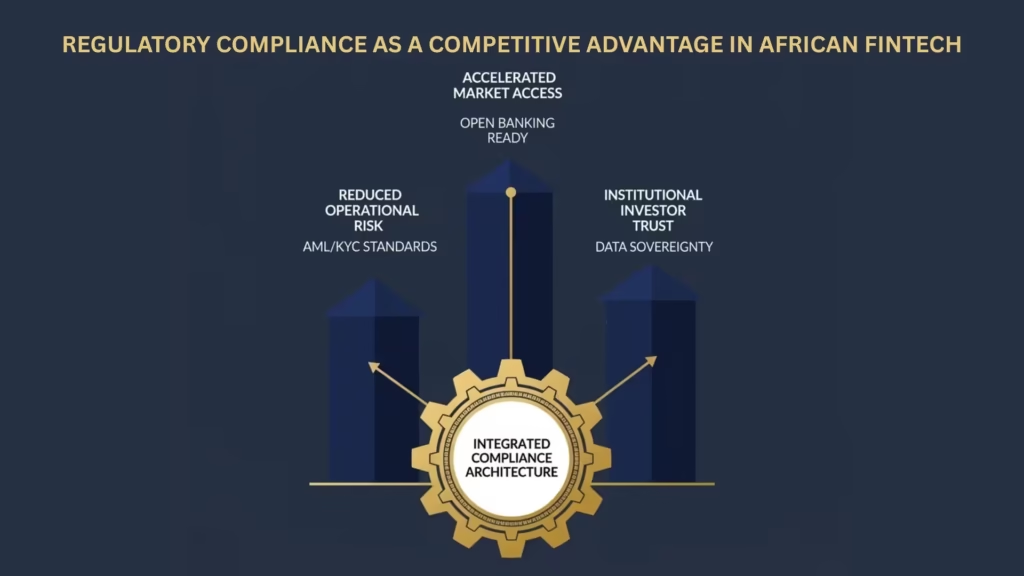
Compliance as the engine of fintech bankability and institutional trust in Africa.
Regulatory Compliance as a Competitive Advantage in African Fintech
This article is in BOH Infrastructure’s Digital Economy and Fintech 2.0 series. The full series establishes that Africa’s digital financial infrastructure has matured beyond the payments layer and is now building the embedded finance and AI backbone that institutional markets require. This briefing focuses on the specific market structures, regulatory dynamics, and hard infrastructure investments that define this next phase.
The Regulatory Maturation Curve
African fintech regulation has followed a broadly consistent pattern across most major markets: an initial period of regulatory permissiveness or ambiguity that enabled rapid experimentation and market entry, followed by a gradual tightening of requirements as regulators developed the technical capacity to oversee digital financial services and as the scale of these platforms made their systemic importance impossible to ignore.
Kenya’s central bank allowed M-Pesa to scale to tens of millions of users under a relatively light-touch regulatory framework before introducing the National Payment System Act and the Mobile Money Regulation that formalised the operational requirements for mobile money operators. Nigeria’s CBN issued the Regulatory Framework for Mobile Money Services in 2009 but significantly strengthened its oversight architecture with the Payment Service Banks regulation in 2018, the Sandbox Regulatory Framework in 2019, and the revised AML and CFT regulations in 2022. South Africa’s Financial Sector Conduct Authority and Prudential Authority have progressively extended their oversight of digital financial service providers under the Financial Sector Regulation Act framework.
This maturation trajectory has two consequences that investors must internalise. First, the window for regulatory arbitrage, in which a platform can operate at scale without bearing the full compliance cost of a licensed financial institution, is closing across all major African markets. Platforms that built their unit economics on the assumption of a low-compliance operating environment are facing structural cost increases as regulatory requirements catch up with their actual activities. Second, the barriers to new entry in regulated digital financial services are rising, creating a more defensible competitive position for incumbent platforms that have already navigated the licensing and compliance infrastructure requirements that new entrants must now meet from day one.
Data Sovereignty and the African Privacy Regulatory Landscape
The development of data protection legislation across Africa has accelerated significantly since 2018, driven partly by the influence of the European Union’s General Data Protection Regulation as a global standard-setter and partly by the growing domestic political salience of data rights in countries where financial and identity data is held predominantly by foreign-owned technology platforms.
Nigeria’s Nigeria Data Protection Act 2023 is the most comprehensive and enforceable data protection legislation on the continent outside South Africa. It establishes clear requirements for lawful bases of processing, data subject rights including access, correction, and erasure, mandatory data protection impact assessments for high-risk processing, and obligations for cross-border data transfer that require adequacy assessments or appropriate safeguards. The Nigeria Data Protection Commission, established by the Act as the independent supervisory authority, has signalled active enforcement intent, including powers to impose administrative fines of up to 2 percent of annual gross revenue for material violations.
Kenya’s Data Protection Act 2019, enforced by the Office of the Data Protection Commissioner, is operationally mature and has produced enforcement action against both local and international organisations processing Kenyan personal data without adequate legal basis. South Africa’s POPIA, fully in effect since July 2021, is the most GDPR-aligned data protection framework in Africa and is increasingly used as a compliance benchmark by organisations seeking to establish data governance standards applicable across their African operations.
For fintech platforms, data protection compliance is not merely a legal obligation. It is an architectural requirement that must be built into technology systems from the design stage rather than bolted on retrospectively. A payment platform that has not designed its data model to support customer data access requests, purpose limitation controls, and retention period enforcement faces a costly and disruptive retrospective engineering exercise when enforcement pressure arrives. A platform that designed for data subject rights from the outset can respond to regulatory requirements and customer requests at minimal marginal cost.
The commercial advantage of privacy-by-design architecture extends beyond regulatory compliance. As African consumers become more aware of their data rights, platforms that can demonstrate transparent and trustworthy data practices are building a customer trust asset that translates into higher retention rates and stronger willingness-to-share, the consent-based data sharing that enables the personalisation and credit intelligence capabilities that differentiate super-app platforms from their competitors.
Open Banking
The Next Regulatory Frontier
Open banking, the regulatory framework requiring financial institutions to share customer account data and enable third-party payment initiation on customer consent through standardised application programming interfaces, is the most consequential regulatory development on the horizon for African fintech competitive dynamics.
The United Kingdom’s Open Banking implementation, which began in 2018, and the European Union’s Payment Services Directive 2 have provided the policy template that African regulators are studying and adapting. Nigeria’s CBN published its Open Banking Regulatory Framework in 2021, creating the foundational policy architecture for a regime that is progressively being operationalised. Ghana’s Bank of Ghana has issued open banking guidelines. South Africa’s National Payment System Department has published a position paper on open banking. Kenya’s regulatory framework is developing through the Kenya Open Finance initiative.
The strategic implication of open banking for fintech competitive dynamics is profound. In a mandatory open banking regime, a customer’s financial data held by their bank or primary payment platform must be made available to licensed third parties, including competing fintech platforms, on the customer’s instruction. This removes a core competitive barrier: the incumbent advantage of holding a customer’s transaction history and account data in a proprietary silo that competitors cannot access.
The platforms best positioned to benefit from open banking are those that are aggregators rather than silos: platforms that can pull customer data from multiple financial institutions, combine it with their own behavioural data, and use the enriched dataset to deliver superior credit decisions, financial planning tools, and personalised product recommendations. This is precisely the data strategy being pursued by leading super-app platforms, which have invested in the technical infrastructure to become open banking data aggregators from the moment the regulatory frameworks become mandatory.
Fintechs that treat open banking as a compliance burden and minimise their investment in API infrastructure and data architecture are making a strategically costly mistake. The platforms building open banking-ready systems now will have operational experience, customer trust, and technical infrastructure that allows them to capture the product innovation opportunities open banking creates from the moment the regulatory switch is flipped. Those building retroactively will be catching up.
AML and KYC as Market Access Infrastructure
Anti-money laundering compliance and know-your-customer procedures are typically presented in the fintech literature as costs of doing business rather than strategic assets. This framing is increasingly inaccurate in the African context, where AML and KYC track records have become primary gatekeeping criteria for three categories of strategic relationship that determine which African fintech platforms achieve scale.
The first category is correspondent banking relationships. African fintechs handling international payments, remittances, or foreign currency transactions require correspondent banking arrangements with global financial institutions that provide access to the international financial system. Global banks including Citibank, Standard Chartered, and Deutsche Bank have significantly tightened their AML due diligence requirements for correspondent relationships with African financial institutions following a series of enforcement actions against large global banks for AML failures in high-risk markets. An African fintech with a documented AML programme, trained compliance staff, effective transaction monitoring systems, and a clean regulatory history can obtain and maintain correspondent relationships that are simply unavailable to platforms without equivalent compliance infrastructure.
The second category is global payment network partnerships. Visa, Mastercard, and the major payment networks impose their own compliance standards on member institutions and technology partners that go beyond local regulatory requirements. Network membership in good standing provides access to global card acceptance, international transaction routing, and co-branded product development opportunities that represent enormous commercial value. Network termination or suspension for compliance failures, which has affected several African payment platforms, is commercially devastating and extremely difficult to reverse quickly.
The third category is institutional investor access. The venture capital and private equity investors who fund African fintech growth stages, and the development finance institutions that provide the debt capital that platforms need to scale their lending books, all conduct AML and compliance due diligence as a standard component of their investment assessment. The difference in due diligence outcomes between platforms with documented, audited compliance programmes and those with informal or underdeveloped compliance infrastructure is material: it affects both the willingness of investors to commit capital and the terms on which they will do so.
The Sandbox as Strategic Tool
Several African financial regulators have introduced regulatory sandbox frameworks that allow fintech companies to test innovative products and business models in a supervised environment with temporary regulatory relief from selected requirements. Nigeria’s CBN Sandbox, Ghana’s Bank of Ghana Fintech and Innovation Office sandbox, Kenya’s Central Bank sandbox, and the South African Intergovernmental Fintech Working Group sandbox are the most active.
The conventional narrative about regulatory sandboxes presents them as a concession to innovation: regulators relaxing their requirements to allow experimentation. The more accurate strategic framing is that sandboxes are an accelerated regulatory relationship development tool. A fintech that participates in a central bank sandbox gains direct supervisory engagement with the regulatory team responsible for its oversight, develops a documented track record of responsible innovation under regulatory observation, and often receives informal guidance on the regulatory pathway to full licensing that is not available to companies that have not participated in sandbox programmes.
The sandbox alumni effect is measurable in several African markets: companies that have participated in central bank sandbox programmes subsequently receive licensing approvals faster, face fewer enforcement actions, and are more frequently consulted in policy development processes than comparable companies that pursued the conventional licensing pathway. The regulatory relationship built through sandbox participation is a genuine and durable competitive asset.
For investors evaluating African fintech platforms, sandbox participation history and the quality of the regulatory relationships it has generated are positive due diligence signals that are underweighted in conventional fintech assessment frameworks focused primarily on revenue growth and unit economics.
The Compliance Technology Stack
Building regulatory compliance infrastructure at the scale required for a growing African fintech super-app requires a dedicated technology stack that is distinct from, though integrated with, the customer-facing product technology. This compliance technology layer is itself an investment area with significant commercial potential.
The core components of the compliance technology stack include transaction monitoring systems that analyse payment flows in real time for suspicious patterns indicating money laundering, fraud, or terrorist financing; identity verification systems integrating biometric authentication, document verification, and national identity database connectivity for KYC procedures; sanctions screening systems checking counterparties against national and international sanctions lists in real time; regulatory reporting systems generating the structured data submissions required by central banks and other supervisory authorities; and data governance platforms managing customer consent records, data retention schedules, and data subject request workflows under applicable data protection legislation.
African fintech platforms are increasingly building or acquiring these compliance technology components rather than relying on manual procedures, driven by the scale at which leading platforms operate and the speed at which regulatory requirements are evolving. The compliance technology vendor market serving African fintechs includes both global providers including Refinitiv World-Check, ComplyAdvantage, and Jumio, and locally developed solutions calibrated to African identity infrastructure and regulatory reporting formats.
For investors, the compliance technology stack is a capex and opex line item that affects platform margins. More importantly, it is an indicator of institutional maturity: platforms that have invested in scalable compliance technology infrastructure are demonstrably better positioned to manage regulatory requirements across multiple African jurisdictions than those relying on spreadsheet-based or manual compliance processes.
Compliance as the AfCFTA Dividend
The progressive implementation of the AfCFTA and the associated harmonisation of financial services regulation across African markets creates an asymmetric benefit for platforms that have built continental-scale compliance infrastructure. A fintech operating across multiple African markets under a fragmented set of national licences and compliance programmes faces growing coordination complexity as it scales. A fintech that has invested in a unified compliance architecture, capable of adapting to national regulatory requirements through configurable parameters rather than completely separate systems, achieves lower marginal compliance cost per new market entry and faster time-to-market for new geographic expansion.
The AfCFTA’s financial services protocol, which commits member states to progressive harmonisation of financial regulation, will over time reduce the regulatory divergence between African markets and lower the compliance cost of operating across them. The platforms building their compliance architecture for continental scale today are positioned to benefit from this harmonisation as it occurs, while their less infrastructure-intensive competitors will face the same investment in compliance architecture but at a later and more compressed timeframe.
Several regional regulatory harmonisation initiatives are already creating sub-continental compliance frameworks that reduce the national fragmentation problem. The East African Community’s payment system harmonisation agenda, the West African Monetary Zone’s financial integration programme, and the SADC central bank cooperation framework are all creating regulatory convergence that increases the value of early investment in compliance infrastructure designed for multi-country operation.
Turn Insight Into Action
We help investors, developers, and institutions move from ideas to bankable, de-risked projects across African markets.
Let’s turn your next investment into a structured success.
Investment Implications
Reading Compliance as a Quality Signal
The investment implication of the compliance-as-competitive-advantage thesis is not simply that investors should avoid platforms with compliance problems, though that is obviously true. It is that compliance infrastructure quality is a leading indicator of platform institutional maturity, management quality, and long-term commercial durability that should be given primary weight in fintech due diligence rather than being treated as a secondary risk mitigation exercise.
Platforms with high-quality compliance infrastructure share a set of organisational characteristics that correlate strongly with investment success: disciplined process orientation, long-term thinking that prioritises sustainable competitive position over short-term growth metrics, ability to recruit and retain high-calibre operational talent, and the institutional credibility with regulators and financial counterparties that opens doors to strategic relationships unavailable to compliance-weak competitors.
Conversely, platforms with compliance deficiencies often share characteristics that signal broader operational or governance risks: growth-at-all-costs cultures that treat regulatory requirements as obstacles rather than guardrails, under-investment in operational infrastructure relative to product and marketing spending, and management teams that lack the financial services institutional background needed to engage productively with supervisory authorities.
The historical record in African fintech supports this correlation. The platforms that have built most durable competitive positions across Nigeria, Kenya, and South Africa are without exception those that invested earliest and most consistently in their regulatory infrastructure. The platforms that have experienced the most severe commercial disruptions are disproportionately those where compliance investment lagged behind growth ambition.
This article is part of Digital Economy and Fintech 2.0 series. The full series establishes that Africa’s digital financial infrastructure has matured beyond the payments layer and is now building the embedded finance and AI backbone that institutional markets require. This briefing focuses on the specific market structures, regulatory dynamics, and hard infrastructure investments that define this next phase. Read the full Digital Economy and Fintech series.
Within this series:
- The super-app consolidation wave is accelerating the compliance divergence between leading platforms and followers. Platforms with unified compliance architectures can absorb acquisition targets and enter new product categories faster and at lower regulatory risk than those managing fragmented compliance programmes across standalone products. → Read Fintech Consolidation 2026: Why Super-Apps are Dominating Tier-1 Markets
- Data center investment and data protection compliance are directly linked: the Nigeria Data Protection Act and equivalent frameworks create the data localisation requirements that make local data center infrastructure a compliance necessity rather than merely a performance preference for Nigeria-focused platforms. → Read The Infrastructure of AI: Nigeria’s First Dedicated Data Centres
Related Articles
- The EU Deforestation Regulation compliance challenge facing West African cocoa producers is structurally analogous to the data protection and AML compliance challenges facing African fintechs: in both cases, early movers who invest in compliance infrastructure gain preferential market access and sustainable competitive advantage over those who treat regulation as an afterthought. → Read From Cocoa to Chocolate: The Industrialization of West African Agribusiness
- The AfCFTA’s financial services harmonisation agenda is the macro framework within which African fintech’s regulatory compliance architecture is being built. Platforms investing now in multi-jurisdictional compliance infrastructure are positioning for the reduced marginal cost of continental expansion that AfCFTA harmonisation will progressively deliver. → Read Financing the AfCFTA: The Role of Infrastructure Bonds and Domestic Pension Funds
Have you Read?
De-risking African Infrastructure Investment
Public-Private Partnerships PPPs: The Future of Infrastructure in Emerging Markets
Turn Insight Into Action
We help investors, developers, and institutions move from ideas to bankable, de-risked projects across African markets.
How We Support You
- Validate opportunities with on-the-ground intelligence
- Structure investments to manage risk and attract capital
- Connect you with trusted partners, financiers, and advisors
- Navigate regulatory, financial, and operational complexity
Why It Matters
Opportunities don’t fail because they lack potential, they fail because they’re not structured to succeed.
Partner with BOH Infrastructure to unlock strategic opportunities in Africa.
Let’s turn your next investment into a structured success.
FAQ: Regulatory Compliance as a Competitive Advantage in African Fintech
What does it mean for a fintech to treat regulatory compliance as a competitive advantage rather than a cost?
It means designing technology systems, data architecture, and operational processes to meet and where possible exceed regulatory requirements from the outset, rather than building for speed and retrofitting compliance when regulatory pressure arrives. The competitive advantage accrues because compliance infrastructure built proactively scales more efficiently than retrofitted compliance, because regulatory approval barriers reduce competitive entry for newcomers, because correspondent banking and payment network relationships require documented compliance programmes, and because institutional investors increasingly use compliance quality as a primary investment assessment criterion.
What are the most important data protection regulations affecting African fintech in 2026?
The most significant are Nigeria’s Nigeria Data Protection Act 2023, enforced by the Nigeria Data Protection Commission with fines of up to 2 percent of annual gross revenue; Kenya’s Data Protection Act 2019, enforced by the Office of the Data Protection Commissioner; and South Africa’s Protection of Personal Information Act (POPIA), fully in effect since July 2021 and the most GDPR-aligned framework on the continent. Together these three frameworks cover Africa’s three largest fintech markets and are increasingly converging toward common standards that benefit platforms building unified continental compliance architectures.
What is open banking and why does it matter for African fintech competitive dynamics?
Open banking is a regulatory framework requiring financial institutions to share customer account data and enable third-party payment initiation through standardised APIs on customer consent. It removes the incumbent advantage of proprietary data silos, allowing competing platforms to access customer transaction history held at other institutions. Nigeria, Ghana, South Africa, and Kenya all have open banking frameworks at various stages of implementation. Platforms building open banking-ready data aggregation infrastructure now will be positioned to capture the product innovation opportunities these frameworks create from the moment mandatory regimes take effect.
How does AML compliance create competitive advantage beyond regulatory risk reduction?
AML compliance quality determines access to three categories of strategic relationship: correspondent banking arrangements that enable international payment and remittance capabilities; global payment network memberships (Visa, Mastercard) that provide card acceptance and international routing; and institutional investor relationships that require documented AML programmes as a prerequisite for capital commitment. These relationships are commercially foundational and systematically unavailable to platforms without high-quality AML infrastructure, making compliance a direct driver of revenue-generating strategic access rather than merely a cost of regulatory adherence.
What is a regulatory sandbox and how does participation create competitive advantage?
A regulatory sandbox is a supervised testing environment where fintechs can pilot innovative products with temporary regulatory relief from selected requirements. Beyond the testing opportunity, sandbox participation creates direct supervisory engagement with the regulatory team, builds a documented track record of responsible innovation under regulatory observation, and generates informal guidance on licensing pathways. Sandbox alumni in several African markets have demonstrably faster licensing approvals, fewer enforcement actions, and stronger regulatory relationships than comparable platforms that pursued conventional licensing pathways. This regulatory relationship capital is a genuine and durable competitive asset.
Why is the compliance technology stack an investment consideration for fintech due diligence?
The compliance technology stack, encompassing transaction monitoring, identity verification, sanctions screening, regulatory reporting, and data governance platforms, is both a margin-affecting cost line and a leading indicator of institutional maturity. Platforms with scalable compliance technology infrastructure are better positioned to manage evolving regulatory requirements across multiple jurisdictions, to absorb acquisition targets with different compliance architectures, and to scale into new product categories without the regulatory disruption that manual or underdeveloped compliance systems generate. The presence or absence of purpose-built compliance technology signals whether a platform is building for sustainable institutional operation or for growth that will require costly compliance remediation as it scales.
How does AfCFTA regulatory harmonisation affect the long-term value of compliance infrastructure investment?
The AfCFTA’s financial services protocol commits member states to progressive harmonisation of financial regulation across participating countries. As this harmonisation occurs, platforms with unified compliance architectures capable of adapting to national requirements through configurable parameters rather than separate systems achieve lower marginal compliance cost per new market entry and faster geographic expansion timelines. The East African Community, West African Monetary Zone, and SADC central bank cooperation frameworks are already creating sub-continental regulatory convergence that increases the value of early investment in multi-jurisdictional compliance infrastructure. Platforms building for AfCFTA-scale compliance architecture now are making an investment whose value compounds as harmonisation progresses.
Share this post:
Know someone who needs to see this? Share it with them!
Ready to explore opportunities in one of Africa’s fastest-growing markets?

Investment
Opportunities in
Africa in 2026
We provide expert guidance on market entry, due diligence, and business development support.
