
The Infrastructure of AI In Africa
Nigeria’s First Dedicated Data Centers
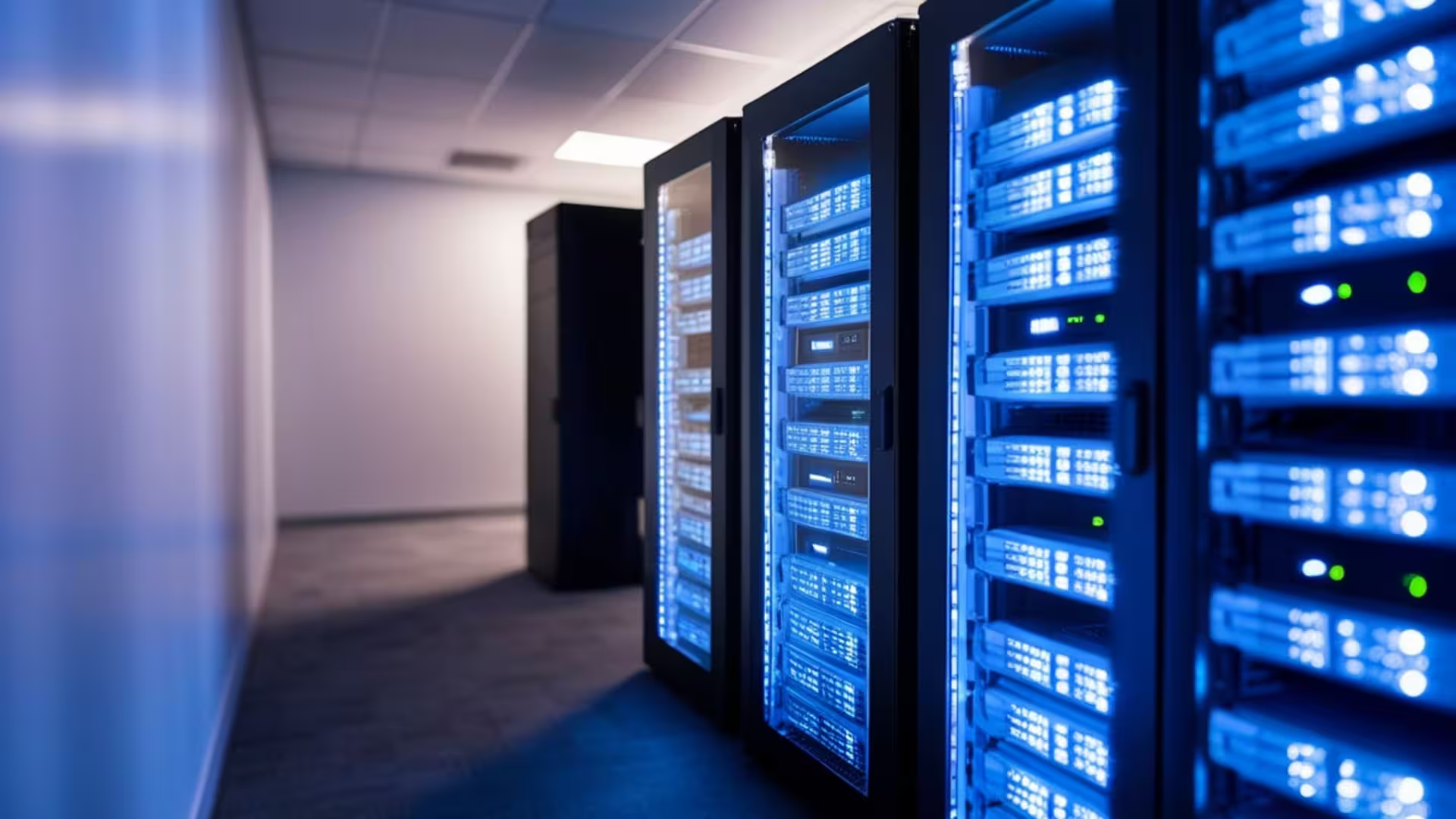
Every AI model trained on Nigerian financial data, every fraud detection algorithm running across a Lagos payment network, every crop yield prediction generated for a smallholder farmer in Kano, and every government identity verification query processed across the National Identity Management Commission’s database requires physical computing infrastructure to execute. That infrastructure, for the vast majority of Nigeria’s digital economy in 2025, sits in data centers in Amsterdam, Dublin, or Ashburn, Virginia, connected to Nigerian users through undersea cables with round-trip latencies that degrade application performance and through data transfer arrangements that create compliance exposure under Nigerian data protection law.
The data center gap is not a minor technical inconvenience. It is a structural constraint on Nigeria’s digital economy development that has direct consequences for the competitiveness of Nigerian technology businesses, the capability of Nigerian government digital services, and the ability of Nigerian AI developers to train and deploy machine learning models on the African datasets that make AI genuinely useful for African applications rather than a set of tools calibrated for problems elsewhere.
The good news is that this gap is now being addressed with the urgency and capital commitment it requires. Nigeria’s data center market is in the early stages of a construction boom that will add more computing capacity in the next five years than the country has accumulated in the preceding two decades. The investment thesis is compelling, the demand signals are clear, and the enabling conditions, while still requiring active management, are more favourable than at any prior point in the market’s development.
KEY TAKEAWAYS
- Nigeria’s data center market is at an inflection point in 2026, with over 150 MW of new colocation capacity either under construction or at advanced planning stage, representing a step-change from the under-20 MW of operational capacity that existed as recently as 2021.
- The economics of African AI development are fundamentally constrained by latency and data sovereignty: running African AI workloads on European or North American cloud infrastructure adds 150 to 200 milliseconds of round-trip latency and creates regulatory compliance exposure under Nigeria’s Nigeria Data Protection Act and similar frameworks across the continent.
- Power supply is the single most critical enabling constraint for Nigerian data center development, with facilities requiring guaranteed, high-quality electricity at power densities of 10 to 20 kW per rack for conventional computing and 40 to 80 kW per rack for AI GPU clusters, levels that the national grid cannot reliably deliver without dedicated on-site generation and backup systems.
- Global hyperscalers including Microsoft, Google, and Amazon Web Services have all announced African cloud region investments, with Nigeria and South Africa as the primary West and Southern African anchor points, creating significant demand for colocation facilities and specialist connectivity infrastructure that local operators are better positioned to provide than the hyperscalers themselves.
- The convergence of a large and growing Nigerian technology sector, an expanding startup ecosystem, fintech super-app platforms with substantial data processing needs, and government digitisation programmes is creating a domestic demand base that makes Nigerian data center investment viable on local market fundamentals, independent of export or regional hub ambitions.
DEFINITION
Data centers are purpose-built facilities housing the physical computing infrastructure, servers, storage systems, networking equipment, power supply units, and cooling systems, that store, process, and distribute digital data.
A dedicated AI data center is a facility specifically engineered for the computational demands of artificial intelligence workloads, which differ significantly from conventional enterprise computing in their power density requirements, cooling architecture, GPU-heavy server configurations, and network throughput needs.
Colocation refers to the business model in which a data center operator provides physical space, power, cooling, and connectivity infrastructure that multiple tenants rent to house their own computing equipment, as distinct from a hyperscale data center built and operated exclusively for the internal use of a single technology company. In the African context, the development of local data center capacity addresses three simultaneous needs: data sovereignty (keeping African data within African jurisdictions), latency reduction (improving the performance of digital services for African end users), and AI capability development (providing the computational infrastructure that African enterprises and governments need to train and deploy machine learning models on African datasets).
Table of Content
The Infrastructure of AI in Africa
This article is in BOH Infrastructure’s Digital Economy and Fintech 2.0 series. The full series establishes that Africa’s digital financial infrastructure has matured beyond the payments layer and is now building the embedded finance and AI backbone that institutional markets require. This briefing focuses on the specific market structures, regulatory dynamics, and hard infrastructure investments that define this next phase.
Why Nigeria and Why Now
Nigeria’s emergence as the primary focus of African data center investment is not accidental. It reflects the intersection of several structural factors that collectively create the most compelling domestic demand case for data center infrastructure of any market in Sub-Saharan Africa.
The first is scale. Nigeria’s population of over 220 million, its status as Africa’s largest economy by GDP, and its position as the continent’s most active technology startup ecosystem create a digital economy of sufficient size to justify dedicated data center investment on local market fundamentals alone. Lagos is home to more technology companies, fintech platforms, and digital service businesses than any other city in Sub-Saharan Africa, and their combined computing and data storage requirements are growing at rates that substantially exceed the capacity of existing colocation facilities.
The second is the maturity of Nigeria’s technology sector. The generation of Nigerian technology companies that reached commercial scale between 2015 and 2022, including Flutterwave, Paystack (acquired by Stripe), Interswitch, Andela, and a cohort of fintech super-apps, are no longer early-stage businesses with modest infrastructure requirements. They are processing millions of transactions daily, maintaining large customer databases, running real-time fraud detection systems, and developing AI-powered product features that require substantial local computing capacity. These are anchor tenants of the calibre that makes data center investment financeable.
The third is regulatory pressure. The Nigeria Data Protection Act 2023, which superseded the earlier Nigeria Data Protection Regulation, establishes explicit requirements for the processing and storage of Nigerian personal data, with provisions that create strong compliance incentives for businesses handling Nigerian customer data to maintain local data residency. While the Act does not impose absolute data localisation requirements, its provisions around cross-border data transfers, impact assessments, and regulatory notification create a compliance architecture that makes local data storage the lower-risk and lower-cost option for Nigeria-focused businesses.
The fourth is the global hyperscaler announcement effect. Microsoft’s Azure announced a West African cloud region anchored in Lagos, and Google Cloud confirmed an African expansion including West African points of presence. These announcements validated the Nigerian market to a global institutional audience and created immediate demand for carrier-neutral colocation facilities, interconnection services, and specialist connectivity infrastructure that the hyperscalers themselves are not positioned to provide independently.
The Physical Requirements of AI Infrastructure
The infrastructure requirements of AI workloads differ from conventional enterprise computing in ways that have direct implications for data center design, construction cost, and operating economics in Nigeria.
Conventional enterprise computing, the servers running email systems, databases, enterprise resource planning software, and web applications, operates at power densities of 2 to 5 kilowatts per rack. Modern data centers designed for conventional computing are typically engineered to handle 5 to 10 kW per rack as their standard operating density, with cooling systems and power distribution infrastructure sized accordingly.
AI training workloads, which require dense clusters of graphics processing units (GPUs) operating in parallel to process the large datasets used to train machine learning models, operate at power densities of 40 to 80 kW per rack for current-generation GPU hardware. The cooling challenge at these densities cannot be solved with the conventional raised-floor air cooling systems that most existing African data centers use. It requires liquid cooling, either direct liquid cooling to the chip level or immersion cooling in which servers are submerged in thermally conductive dielectric fluid, technologies that are standard in new hyperscale AI infrastructure globally but at an early stage of deployment in African data center markets.
The power quality requirements of AI workloads are also more stringent than for conventional computing. A GPU cluster interrupted by a power fluctuation does not simply pause and resume: it loses the computational progress of the current training run, potentially representing hours or days of processing time. Uninterruptible power supply systems and diesel generator backup capacity must be sized not merely for load continuity but for seamless transition quality that prevents the voltage and frequency disturbances that would otherwise corrupt running AI jobs.
These requirements have direct implications for the capital cost of AI-capable Nigerian data centers. A facility engineered for conventional enterprise colocation at 5 kW per rack can be built for approximately USD 5 to 7 million per megawatt of IT load capacity in a Nigerian context. An AI-capable facility with liquid cooling infrastructure and the power systems required for high-density GPU clusters costs USD 12 to 18 million per megawatt, more than double the conventional cost, before the premium for reliable power supply in a grid environment where the national supply is inadequate is factored in.
Power
The Defining Constraint
Every discussion of Nigerian data center development arrives at the same constraint within the first few minutes: power. Nigeria’s national grid has an installed generation capacity of approximately 13,000 MW against a theoretical demand of 30,000 MW or more, and actual available generation has rarely exceeded 5,000 MW consistently due to gas supply constraints, transmission losses, and distribution infrastructure deficiencies. Industrial electricity consumers in Nigeria routinely experience 8 to 16 hours of grid outages daily, supplemented by diesel generators that add USD 0.25 to USD 0.40 per kilowatt-hour to effective electricity costs.
For a data center requiring 10 MW of continuous, high-quality power supply, this grid environment is simply incompatible with standard operational requirements without dedicated on-site generation infrastructure. The Nigerian data center operators who have achieved commercial operational status have all resolved this constraint through the same approach: on-site captive gas-fired or diesel generation capacity sized for 100 percent of load, with grid connection retained as a supplementary and backup source rather than the primary supply.
The capital cost of this power independence is substantial. A 10 MW captive gas generation plant, including the gas supply infrastructure, generator sets, automatic transfer switching, and uninterruptible power supply systems, adds USD 8 to 12 million to the capital cost of a data center that would require only USD 1 to 2 million in backup power systems in a market with reliable grid supply. This power premium is the single largest driver of the higher all-in capital cost of Nigerian data center development compared to equivalent facilities in Europe or North America.
The transition to renewable energy for data center power supply is gaining traction in the Nigerian market for reasons that go beyond environmental policy. Solar power, combined with battery storage, is increasingly competitive with diesel generation on a levelised cost basis for the daytime portion of data center load, and several developers are incorporating solar canopies and battery backup systems into their facility designs. Gas-fired generation remains necessary for overnight load and for the high-density power requirements of AI GPU clusters, but hybrid renewable and gas systems offer a pathway toward both lower operating costs and improved sustainability credentials for data center operators targeting global technology company tenants with net-zero supply chain commitments.
The Emerging Developer Landscape
The Nigerian data center market is being developed by three distinct categories of operator, each with different capital structures, strategic objectives, and competitive positioning.
Pan-African specialist data center developers represent the most strategically focused category. Rack Centre, established in Lagos in 2013 and now the most established carrier-neutral colocation provider in Nigeria, operates a Tier III certified facility and has completed multiple capacity expansion phases driven by demand from financial institutions, telecoms operators, and technology companies. MainOne, originally established as an undersea cable operator, has developed an integrated model combining subsea connectivity, data center colocation, and managed cloud services that creates a differentiated competitive position relative to pure-play colocation providers. Equinix, the global data center and interconnection platform, entered the Nigerian market through acquisition and is applying its global interconnection platform model to connect Nigerian enterprises to global cloud providers and international networks.
African private equity-backed developers represent a second category, typically structured as local operating companies with regional PE fund backing and an international data center operator as a technical partner. Several transactions of this structure have been completed or are in advanced development across Nigeria and South Africa, combining local market knowledge and regulatory relationships with international operational expertise and access to capital markets.
Telecoms operator-backed data center development is the third category, led by MTN and Airtel, both of which have existing tower infrastructure, power management expertise, and enterprise customer relationships that provide a natural foundation for data center and edge computing development. The edge computing dimension, specifically the deployment of small-format computing facilities at existing telecoms tower sites to reduce latency for applications requiring real-time responsiveness, is an extension of the data center investment thesis that telecoms operators are uniquely positioned to execute.
Turn Insight Into Action
We help investors, developers, and institutions move from ideas to bankable, de-risked projects across African markets.
Let’s turn your next investment into a structured success.
The AI Application Layer
What the Infrastructure Enables
The investment case for Nigerian data center infrastructure is ultimately grounded in the AI and digital applications that the infrastructure enables. Understanding what those applications are and why they require local infrastructure is essential for investors assessing the demand durability of the data center thesis.
Financial services AI is the largest immediate demand category. Nigeria’s fintech super-apps are running fraud detection models, credit underwriting algorithms, customer behaviour analysis, and anti-money laundering screening systems that process millions of transactions daily. The latency sensitivity of real-time fraud detection, which must return a decision within milliseconds of a transaction being initiated, makes local compute infrastructure not merely preferable but functionally necessary for effective fraud prevention. A fraud detection query routed to a European data center and back adds 150 to 200 milliseconds to transaction processing time, enough to degrade user experience and in some payment architectures to create transaction timeout risks.
Government digital services represent the second largest demand category. The Nigerian government’s digital transformation agenda, encompassing the National Identity Management Commission’s biometric database, the Federal Inland Revenue Service’s digital tax administration system, the Integrated Payroll and Personnel Information System managing civil service payroll, and a growing range of state-level digital service platforms, generates data processing requirements that the government has explicit policy reasons to maintain within Nigerian jurisdiction. The National Information Technology Development Agency has articulated a government cloud policy that prioritises local data center capacity for government workloads, creating a structured procurement pipeline for Nigerian data center operators.
The emerging Nigerian AI research and development community, anchored by academic institutions including the University of Lagos and the African Institute for Mathematical Sciences, corporate AI research teams at major Nigerian financial institutions and technology companies, and an expanding cohort of AI startups, represents a smaller but strategically significant demand category for GPU compute access. These users are currently primarily served by global cloud providers, but local colocation and cloud services can be cost-competitive for sustained training workloads where the bandwidth costs of moving large datasets to and from offshore compute infrastructure are factored into the total cost of ownership.
The Regional Hub Ambition
Beyond serving the Nigerian domestic market, the most ambitious Nigerian data center operators are positioning Lagos as the connectivity hub for West African digital infrastructure. This regional hub ambition has geographic logic: Lagos sits at the landing point of multiple major subsea cable systems connecting West Africa to Europe, South America, and Asia, making it the most connected city in the region for international bandwidth.
The West African subsea cable infrastructure has expanded substantially over the past five years. The 2Africa cable system, backed by a consortium including Meta and several African telecoms operators and operational from 2024, encircles the African continent and provides multiple redundant landing points that reduce West Africa’s dependence on the single cable systems that previously created significant single points of failure in the region’s international connectivity. The Equiano cable, Google’s dedicated subsea cable landing in Nigeria and several other African countries, provides additional high-capacity, low-latency connectivity specifically engineered for cloud services traffic.
This cable infrastructure positions a well-connected Nigerian data center as not merely a domestic computing facility but a regional interconnection point where West African enterprises can access global cloud providers, international financial networks, and content delivery infrastructure at lower latency and higher reliability than alternative routing through North African or South African landing points.
The regional hub revenue opportunity extends the addressable market for Nigerian data center operators beyond Nigeria’s 220 million people to the broader West African market of over 400 million people across ECOWAS member states, many of whom will access digital infrastructure through Lagos-based facilities given the relative underdevelopment of data center capacity in Ghana, Senegal, Ivory Coast, and other West African markets.
Risk Register and Investment Considerations
Nigerian data center investment carries five principal risks that institutional investors must model carefully.
Currency risk is the most pervasive. Data center equipment is priced in USD, financing is typically structured in USD or euros, and operating costs including fuel, spare parts, and specialist technical staff have significant hard currency components. Revenue is earned in Nigerian naira, which has experienced significant depreciation over the past several years. The structural solution is to price colocation services in USD with naira settlement at the prevailing exchange rate, which several Nigerian operators do, but this transfers currency risk to tenants and requires careful contract structure to maintain commercial relationships through periods of acute exchange rate volatility.
Power cost risk is the second major factor. Diesel generation at Nigerian data centers creates operating cost exposure to global oil prices and local fuel distribution dynamics that can significantly affect the economics of facilities without captive gas or renewable power infrastructure. The transition to gas-fired and hybrid renewable generation reduces but does not eliminate this exposure.
Regulatory risk around data localisation requirements cuts in both directions. Stricter data localisation mandates would increase domestic demand for Nigerian data centers but could also impose compliance costs and operational constraints on international tenants. Relaxation of data localisation requirements would reduce the compliance-driven demand for local infrastructure but improve the operating environment for international cloud providers, which are significant indirect demand drivers.
Technical talent risk reflects the current shortage of data center engineers, facilities managers, and network operations specialists with the qualifications required to operate Tier III and Tier IV certified facilities. Several Nigerian data center operators have established training programmes in partnership with international certification bodies, but the talent pipeline is at an early stage relative to the sector’s growth trajectory.
Tenure and land title risk, while not specific to data centers, affects all capital-intensive real estate development in Lagos, where clear and unencumbered land title is more difficult to establish than in many comparable markets. Operators who have resolved this risk through long-term ground lease structures with creditworthy counterparties have addressed a due diligence requirement that greenfield developers must factor into project timelines and costs.
This article is part of Digital Economy and Fintech 2.0 series. The full series establishes that Africa’s digital financial infrastructure has matured beyond the payments layer and is now building the embedded finance and AI backbone that institutional markets require. This briefing focuses on the specific market structures, regulatory dynamics, and hard infrastructure investments that define this next phase.. Read the full Digital Economy and Fintech series.
Within this series:
- Nigeria’s fintech super-app platforms are among the largest and most latency-sensitive consumers of local data center capacity. The computing infrastructure examined in this article is the physical foundation on which the AI-driven personalisation and real-time fraud detection capabilities of leading super-apps are built. → Read Fintech Consolidation 2026: Why Super-Apps are Dominating Tier-1 Markets
- The Nigeria Data Protection Act and its equivalents across African jurisdictions are the regulatory framework creating the data localisation demand that underpins Nigerian data center investment. The compliance architecture being built by leading African fintechs is inseparable from their data infrastructure decisions. → Read Regulatory Compliance as a Competitive Advantage in African Fintech
Related Articles
- Data centers are among the most power-intensive commercial consumers of electricity. Kenya’s low-cost, reliable geothermal electricity makes Nairobi a structurally attractive location for data center development serving East African markets, with a fundamentally better power economics profile than Lagos-based facilities dependent on diesel generation. → Read Kenya’s Geothermal Advantage: A Blueprint for Regional Energy Security
- The AI models underpinning satellite crop analysis, soil nutrition recommendations, and credit underwriting for African smallholder platforms require substantial data processing infrastructure. Nigerian and Kenyan data center development directly enables the next generation of agricultural AI capability that the precision farming investment thesis depends on. → Read Climate-Smart Farming: Investing in Precision Ag-Tech for Smallholders
Have you Read?
De-risking African Infrastructure Investment
Public-Private Partnerships PPPs: The Future of Infrastructure in Emerging Markets
Turn Insight Into Action
We help investors, developers, and institutions move from ideas to bankable, de-risked projects across African markets.
How We Support You
- Validate opportunities with on-the-ground intelligence
- Structure investments to manage risk and attract capital
- Connect you with trusted partners, financiers, and advisors
- Navigate regulatory, financial, and operational complexity
Why It Matters
Opportunities don’t fail because they lack potential, they fail because they’re not structured to succeed.
Partner with BOH Infrastructure to unlock strategic opportunities in Africa.
Let’s turn your next investment into a structured success.
FAQ: The Infrastructure of AI in Africa
Why does Africa need its own dedicated data centers rather than using global cloud infrastructure?
Three factors make local data center infrastructure necessary rather than optional for Africa’s digital economy. First, latency: AI applications including real-time fraud detection, voice recognition, and recommendation systems require round-trip response times below 20 milliseconds that are physically impossible when data must travel to European or North American servers and back. Second, data sovereignty: Nigerian and broader African data protection regulations create compliance requirements for local data processing that offshore infrastructure cannot satisfy. Third, cost: bandwidth costs for moving large datasets to offshore compute infrastructure make local processing economically competitive for sustained workloads even where pure compute costs favour global cloud providers.
What makes Nigeria specifically the leading African data center market?
Nigeria’s combination of scale (220 million people, Africa’s largest economy), a mature technology and fintech sector generating substantial domestic compute demand, multiple major subsea cable landing points making Lagos the best-connected city in West Africa, hyperscaler investment announcements that have validated the market, and a regulatory framework creating data localisation incentives makes it the most commercially compelling data center market in Sub-Saharan Africa outside South Africa.
How does AI change the infrastructure requirements of data centers compared to conventional computing?
AI training workloads use GPU clusters that operate at power densities of 40 to 80 kilowatts per rack, compared to 2 to 5 kW for conventional enterprise servers. This requires liquid cooling systems rather than conventional air cooling, power distribution infrastructure designed for high-density loads, and uninterruptible power supply systems capable of seamless transition quality that prevents voltage disturbances from corrupting running AI jobs. These requirements more than double the capital cost of an AI-capable facility relative to a conventional colocation data center.
How is the power supply problem being solved for Nigerian data centers?
Leading Nigerian data center operators have adopted power independence as their operational standard: on-site captive generation, either gas-fired or increasingly hybrid gas and solar, sized for 100 percent of facility load with grid connection retained as backup rather than primary supply. This adds USD 8 to 12 million to the capital cost of a 10 MW facility but is the only reliable path to the continuous, high-quality power that data center tenants require. The transition toward gas-fired and solar-hybrid generation is reducing diesel dependency and improving both cost and sustainability profiles.
Which global technology companies have announced African data center investments and what does this mean for local operators?
Microsoft Azure, Google Cloud, and Amazon Web Services have all announced African cloud region investments, with Nigeria and South Africa as the primary West and Southern African anchor points. These announcements benefit local colocation operators because the hyperscalers themselves do not typically build the carrier-neutral interconnection facilities that allow multiple cloud providers and enterprise customers to exchange traffic. Local colocation operators providing interconnection services become essential neutral infrastructure in a market where multiple global cloud providers are simultaneously establishing local presence.
What is the regional hub opportunity for Nigerian data centers?
Lagos sits at the landing point of multiple major subsea cable systems including the 2Africa and Equiano cables, making it the most internationally connected city in West Africa. A well-connected Nigerian data center can serve not just the 220 million Nigerian domestic market but act as the regional interconnection hub for the broader 400 million-person West African market, with tenants in Ghana, Ivory Coast, Senegal, and other ECOWAS countries accessing global cloud and network infrastructure through Lagos-based facilities given the relative underdevelopment of data center capacity elsewhere in the region.
What are the main investment risks in Nigerian data center development?
The five principal risks are: currency risk from the mismatch between USD-denominated capital costs and naira revenues; power cost risk from diesel price exposure for facilities without captive gas or renewable generation; regulatory risk around evolving data localisation requirements; technical talent risk reflecting the current shortage of qualified data center operations specialists; and land title risk affecting capital-intensive real estate development in Lagos. Operators who have structured USD-denominated colocation contracts, secured captive gas generation, and resolved land title through ground lease arrangements with creditworthy counterparties have mitigated the most significant of these risks.
Share this post:
Know someone who needs to see this? Share it with them!
Ready to explore opportunities in one of Africa’s fastest-growing markets?
Investment
Opportunities in
Africa in 2026
We provide expert guidance on market entry, due diligence, and business development support.
