
Port Modernization
Lessons from Tanger Med and Mombasa in 2026
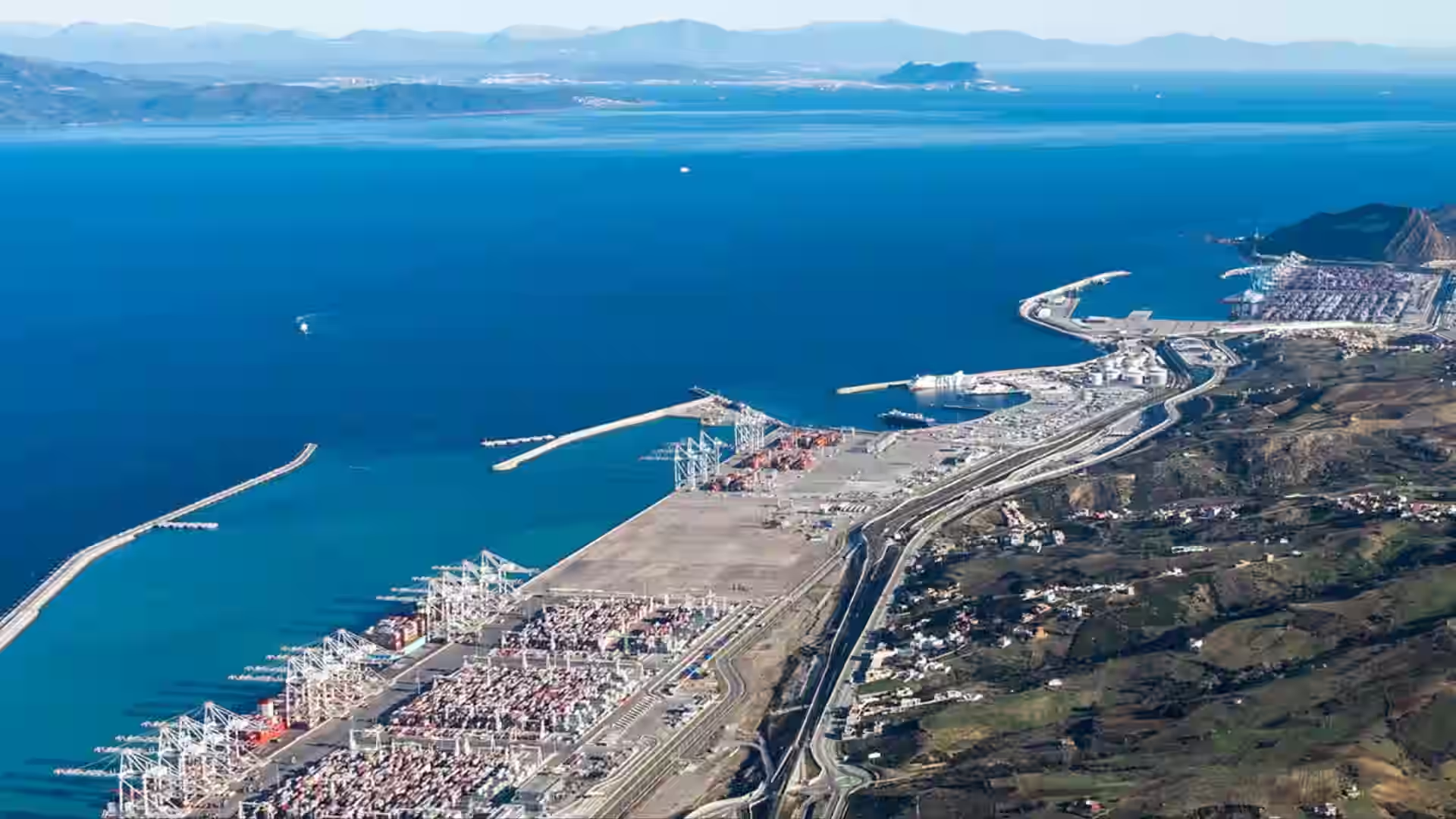
A ship that arrives at the Port of Rotterdam, unloads its containers, loads outbound cargo, and departs takes on average less than 24 hours from arrival to departure. The same vessel arriving at several major African ports can wait at anchor for 3 to 5 days before berthing, spend a further 2 to 3 days on cargo operations, and then navigate a documentation and customs clearance process that adds another 5 to 10 days before containers are released to importers. The difference between those two experiences is not primarily a function of cargo volume or vessel size. It is a function of infrastructure quality, operational systems, institutional efficiency, and regulatory design.
That gap has an enormous economic cost. African importers pay freight rate premiums for routes to and from the continent because shipping lines price port inefficiency into their tariffs. African exporters, particularly of time-sensitive perishable goods, face competitive disadvantages in global markets because unreliable port performance makes delivery windows unpredictable. Manufacturers considering African locations for production calculate port turnaround risk into their supply chain models and frequently find that the risk premium pushes decisions toward alternative locations.
Tanger Med and Mombasa represent two quite different approaches to closing this gap, in different regional contexts, with different ownership structures, and at different stages of development. Both offer lessons that are immediately applicable to the port development agenda across the rest of the continent.
The lessons from Tanger Med and Mombasa translate into a set of principles that apply to the port modernization agenda across the rest of the African continent, where a substantial number of ports are at various stages of modernization planning or early implementation.
KEY TAKEAWAYS
- Tanger Med has grown from a greenfield construction site in 2002 to the largest port in Africa and the Mediterranean by container throughput, handling over 10 million twenty-foot equivalent units (TEUs) annually and demonstrating that African ports can compete at global scale when infrastructure investment and institutional quality align.
- Mombasa’s ongoing modernization, including the Mombasa Port Development Programme and the Kenya Ports Authority’s digital transformation agenda, is progressively reducing the cargo dwell times and vessel turnaround delays that have historically constrained East African trade competitiveness.
- The Single Window system, which consolidates all import and export documentation requirements into a single digital platform connecting customs, port authority, shipping agents, and verification agencies, is the single most commercially impactful reform available to African ports and is being rolled out with varying speeds and effectiveness across the continent.
- Africa’s ports lose an estimated USD 10 billion annually in economic value through preventable inefficiency, including excessive dwell times, informal payments, redundant documentation requirements, and inadequate cargo handling equipment, a figure that represents both the cost of the status quo and the value creation potential of modernization.
- The emergence of private port terminal operators, including DP World, APM Terminals, and Bolloré Africa Logistics (now TIL), as long-term concession holders in African ports is the primary commercial mechanism through which international best practice in port operations is being transferred to the continent.
DEFINITION
Port modernization refers to the systematic upgrade of a seaport’s physical infrastructure, operational systems, and institutional governance to reduce ship turnaround times, lower handling costs, increase cargo throughput capacity, and improve the reliability and predictability of maritime trade. In the African context, modernization typically encompasses dredging to accommodate larger vessels, installation of modern container handling equipment such as ship-to-shore cranes and automated stacking systems, implementation of digital port management and cargo tracking systems, reform of customs and border agency procedures through Single Window platforms, and development of integrated logistics zones adjacent to port boundaries.
Turnaround time, the elapsed period from a vessel’s arrival at the pilot station to its departure after cargo operations, is the primary operational metric by which port competitiveness is measured: every additional day a vessel waits at anchor or in berth represents a direct cost to the shipping line that is ultimately priced into the freight rates paid by African importers and exporters.
Table of Content
Port modernization: Lessons from Tanger Med and Mombasa in 2026
This article is in BOH Infrastructure’s Infrastructure and Trade Corridors series. The full series establishes that physical connectivity is the single largest multiplier of AfCFTA value, and that the perception of African infrastructure risk consistently overstates the actual execution record. This briefing focuses on the specific corridors, port assets, and financing instruments that are closing the gap between ambition and delivery.
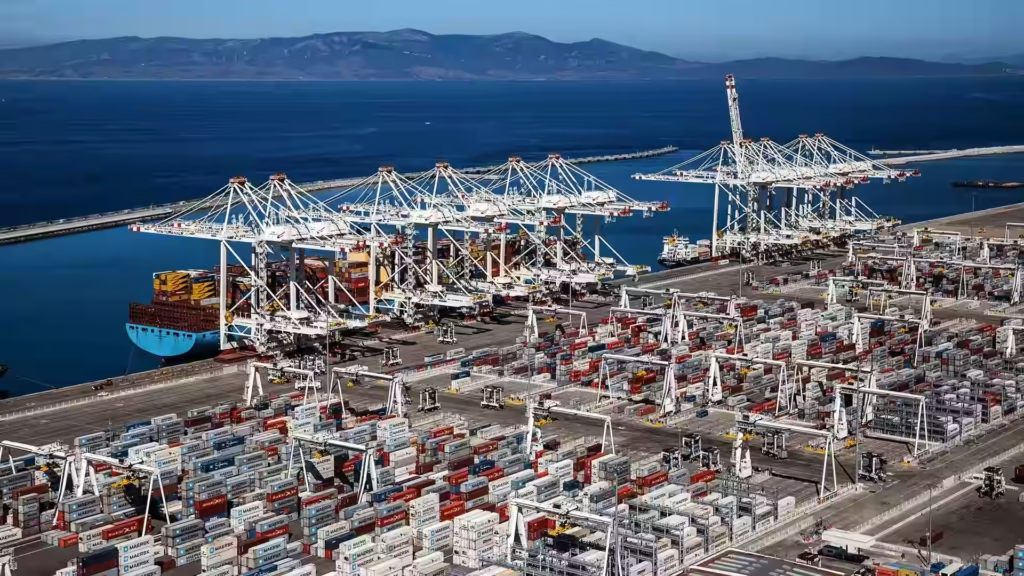
Image Source: Tanger Med Port Authority
Tanger Med
Building a Global Hub from Scratch
The story of Tanger Med is one of the most instructive infrastructure development case studies in Africa and arguably in the world. In 2002, the site on Morocco’s Mediterranean coast where the port now stands was a modest fishing area with no deep-water infrastructure. By 2026, Tanger Med handles over 10 million TEUs of container traffic annually, making it the largest port in Africa, the largest on the Mediterranean coast, and one of the top 20 container ports globally by throughput volume.
The transformation was achieved through a combination of deliberate policy design, sustained sovereign investment, and strategic positioning relative to global shipping route geography. The port sits at the western entrance to the Mediterranean, almost exactly on the main Atlantic shipping lane connecting Europe, Asia, and the Americas through the Suez Canal. This geographic position means that global carrier alliances can use Tanger Med as a transshipment hub, offloading containers from large vessels onto smaller feeder ships serving Spanish, French, Italian, and North African ports, without significantly deviating from their primary route. The economic logic of transshipment concentration at a well-positioned hub is powerful: it generates port revenue from cargo that is not destined for Morocco at all, subsidising the cost of port infrastructure that serves Moroccan importers and exporters.
The institutional design of Tanger Med is as important as its geography. The Tanger Med Port Authority (TMPA) was established as an autonomous body with a mandate to develop the port complex free from the bureaucratic constraints and political interference that have historically limited the ambitions of state-operated African port authorities. The TMPA operates on commercial principles, setting tariffs competitively, investing port revenues in infrastructure expansion, and managing concession agreements with private terminal operators on commercially negotiated terms.
APM Terminals and CMA CGM’s terminal arm operate the two main container terminals under long-term concessions, bringing global operational standards, international shipping line relationships, and capital investment capacity that supplement the Moroccan state’s infrastructure spending. The concession model has been the key to Tanger Med’s operational quality: private terminal operators competing for shipping line calls have a direct financial incentive to minimise turnaround times, invest in productive handling equipment, and adopt digital management systems that improve transparency and predictability for vessel operators.
Beyond container handling, Tanger Med has developed into a fully integrated logistics and industrial platform. The Tanger Med Special Economic Zone, adjacent to the port, houses automotive manufacturers including Renault-Dacia and Stellantis, as well as aerospace, textile, and electronics assembly operations that export directly through the adjacent port. This combination of port and industrial zone has created a mutually reinforcing dynamic: the industrial zone generates cargo for the port, and port efficiency reduces the logistics cost of the industrial zone’s exports, making both more competitive than either would be in isolation.
The Tanger Med model is not directly replicable everywhere. Its geographic position at the Mediterranean-Atlantic junction is a natural advantage that most African ports do not share. But several of its institutional and design elements are transferable: autonomous port authority governance, competitive concession structures for terminal operations, integration of port and industrial zone development, and a clear strategic positioning decision about what traffic the port is competing for and why.
Mombasa Port
Reforming an Incumbent Port
Mombasa occupies a fundamentally different starting position from Tanger Med. Rather than a greenfield development on an optimal site, Mombasa is Kenya’s primary port and East Africa’s most important maritime gateway, with over a century of operating history, deeply embedded institutional structures, a complex relationship between the Kenya Ports Authority (KPA) and multiple government ministries, and a physical layout that reflects the infrastructure decisions of a different commercial era.
The challenge of modernising an incumbent port like Mombasa is in several ways harder than building a new one. Physical constraints, including the channel depth, the berth layout, and the land available for yard expansion, cannot be redesigned from scratch. Institutional practices and informal economic arrangements that have accumulated over decades create resistance to reform that a greenfield port authority does not face. Existing shipping line relationships and cargo routing patterns create path dependency that even genuine operational improvements take time to shift.
Despite these constraints, Mombasa has made measurable progress across several dimensions of port modernization over the 2020 to 2026 period. The Port of Mombasa Development Programme, supported by financing from the Japan International Cooperation Agency (JICA) and the African Development Bank, has added new berth capacity at the container terminal, installed additional ship-to-shore cranes capable of handling the post-Panamax vessels that now dominate major shipping routes, and expanded the container yard with rubber-tyred gantry cranes that improve stacking density and reduce horizontal transport within the terminal.
The KPA’s digital transformation programme has delivered a Port Community System that connects shipping agents, clearing agents, customs, the Kenya Revenue Authority, and verification agencies on a single platform, reducing the number of physical document submissions required and enabling electronic pre-arrival processing that compresses customs clearance timelines. Average cargo dwell time at Mombasa, defined as the time from a container’s discharge from a vessel to its exit from the port gate, has declined from over 10 days in 2018 to approximately 4 to 5 days by 2025 for import containers, a significant improvement that nonetheless leaves substantial room for further gains toward the 2 to 3 day benchmarks of East Asian ports operating at comparable throughput levels.
The Standard Gauge Railway connecting Mombasa to Nairobi, and eventually to the East African interior, has added an important dimension to Mombasa’s logistics proposition. Rail evacuation of containers from the port reduces congestion on the Mombasa-Nairobi highway, which had become a significant constraint on the port’s effective throughput capacity despite adequate berth and yard operations. The SGR’s operational limitations and the debate about its financial sustainability should not obscure its fundamental contribution to port system efficiency: a congested landside logistics chain can cap effective port throughput just as effectively as inadequate quay crane capacity.
The Single Window
The Most Impactful Reform Available
Across both Tanger Med and Mombasa, and across the broader African port modernization landscape, the implementation of an electronic Single Window system for trade documentation stands out as the single reform with the highest ratio of economic impact to implementation cost available to port and customs authorities.
A Single Window system consolidates the multiple document submissions, agency authorisations, and manual verification processes that characterise traditional trade clearance into a single digital platform where all required submissions are made once, routed automatically to the relevant agencies, and processed in parallel rather than sequentially. The time savings are substantial: processes that require 5 to 7 days of sequential document presentation, review, and approval in a manual system can be compressed to 24 to 48 hours in a well-implemented Single Window.
The economic literature on Single Window implementation in developing countries consistently shows benefit-cost ratios of 5 to 1 or higher, driven by reductions in dwell time, elimination of informal payment requirements, and the administrative cost savings to traders from reduced physical document handling. The World Bank’s Doing Business index improvements attributed to Single Window implementation in several African countries (Kenya, Rwanda, Senegal, and Ghana) illustrate the commercial significance of this reform.
The implementation challenge is institutional rather than technical. The technology for Single Window systems is mature and available from multiple vendors. The barrier to implementation is almost always the reluctance of individual government agencies to surrender their document processing autonomy and the informal revenue streams associated with manual clearance processes. Sustained political commitment at the head of government level, combined with technical assistance from development finance institutions, has been the consistent success factor in African Single Window implementations that have achieved meaningful operational impact rather than becoming well-funded but underutilised systems.
Turn Insight Into Action
We help investors, developers, and institutions move from ideas to bankable, de-risked projects across African markets.
Let’s turn your next investment into a structured success.
Private Terminal Operators
The involvement of international private port terminal operators through long-term concession agreements is the most reliable mechanism for transferring global operational best practice into African port environments. DP World (Dubai Ports World), APM Terminals (a subsidiary of the AP Moller-Maersk group), and TIL (Terminal Investment Limited, formerly Bolloré Africa Logistics’s terminal operations) collectively operate terminals at numerous African ports including Djibouti, Dakar, Abidjan, Lagos, Mombasa, Dar es Salaam, Walvis Bay, and Luanda.
These operators bring capital investment capacity that most African state port authorities cannot match, global management systems and operational procedures developed across dozens of major international terminals, technology infrastructure including terminal operating systems, gate automation, and vessel planning software that enables the throughput rates and turnaround times that modern shipping lines require, and shipping line relationships that can direct cargo routing decisions.
The concession model is not without tensions. African governments have in several cases revisited concession terms they view as insufficiently beneficial to state interests, and the balance between private operator efficiency and public accountability for strategic national infrastructure is a genuine governance challenge. The Conakry port concession dispute in Guinea, the Djibouti port dispute with DP World, and periodic renegotiation pressures in other markets illustrate that concession stability, while generally good in major markets, cannot be assumed as a permanent feature of any African port investment.
For investors assessing port infrastructure opportunities, the track record of specific operators in managing government relationships and adapting to local institutional contexts is therefore a material due diligence consideration alongside the conventional financial and operational analysis.
The Emerging Port Modernization Agenda
Lessons for the African Continent
The lessons from Tanger Med and Mombasa translate into a set of principles that apply to the port modernization agenda across the rest of the African continent, where a substantial number of ports, including Dar es Salaam, Lagos (Apapa), Abidjan, Tema, Luanda, Maputo, and Beira, are at various stages of modernization planning or early implementation.
The first lesson is that geography and strategic positioning must drive port investment decisions before infrastructure planning begins. A port that is not on a natural shipping route, does not serve a significant economic hinterland, and cannot compete for transshipment traffic on cost or transit time grounds cannot be made competitive through infrastructure investment alone. Capital deployment must follow strategic logic, not political geography.
The second lesson is that institutional reform delivers more economic value per dollar spent than physical infrastructure in most incumbent African ports. A new container crane at a port with 10-day dwell times and dysfunctional customs clearance delivers a fraction of its potential value. The same infrastructure investment combined with a functioning Single Window, reformed customs procedures, and competent terminal management can reduce dwell times by 60 to 70 percent and transform the port’s trade competitiveness.
The third lesson is that the port and its hinterland logistics system must be planned and invested as a single integrated system rather than as separate infrastructure domains. Mombasa’s experience with highway congestion constraining terminal throughput is a universal lesson: a port is only as competitive as the weakest link in the door-to-door logistics chain it sits within.
The fourth lesson, perhaps the most important for investor positioning, is that port modernization timelines are long and the economic value created accrues progressively over decades rather than over project finance cycles. The most appropriate capital for port infrastructure is patient capital with long time horizons: pension funds, sovereign wealth funds, and development finance institutions that can match their return expectations to the genuine pace of port system transformation.
This article is part of Infrastructure and Trade Corridors series. The full series establishes that physical connectivity is the single largest multiplier of AfCFTA value, and that the perception of African infrastructure risk consistently overstates the actual execution record. This briefing focuses on the specific corridors, port assets, and financing instruments that are closing the gap between ambition and delivery. Read the full Infrastructure and Trade Corridors series.
Within this series:
- Lobito port is the western anchor of the Lobito Corridor and its development mirrors the modernization challenges examined here. The operational standards being set at Tanger Med provide the benchmark that Lobito’s development programme is being designed to approach. → Read The Lobito Corridor: Reimagining Central African Logistics
- Port infrastructure requires the longest-duration capital of any African infrastructure category. The domestic pension fund mobilisation strategies being developed for AfCFTA infrastructure financing are particularly well suited to port asset investment given the matching of long-duration liabilities and slow-maturing infrastructure returns. → Read Financing the AfCFTA: The Role of Infrastructure Bonds and Domestic Pension Funds
Related Articles
- Export horticulture cold chains terminate at the port cargo facility. Port-level cold storage and temperature-controlled cargo handling are the final link in East and North Africa’s fresh produce export chains, and their modernization directly determines the export competitiveness of high-value agricultural products. → Read Cold Chain Logistics: The USD 50 Billion Opportunity in Africa’s Perishable Markets
- The development of industrial processing zones adjacent to West African ports, following the Tanger Med Special Economic Zone model, is a core mechanism for retaining value in cocoa and other commodity supply chains within Africa rather than exporting raw materials for processing elsewhere. → Read From Cocoa to Chocolate: The Industrialization of West African Agribusiness
Have you Read?
De-risking African Infrastructure Investment
Public-Private Partnerships PPPs: The Future of Infrastructure in Emerging Markets
Turn Insight Into Action
We help investors, developers, and institutions move from ideas to bankable, de-risked projects across African markets.
How We Support You
- Validate opportunities with on-the-ground intelligence
- Structure investments to manage risk and attract capital
- Connect you with trusted partners, financiers, and advisors
- Navigate regulatory, financial, and operational complexity
Why It Matters
Opportunities don’t fail because they lack potential, they fail because they’re not structured to succeed.
Partner with BOH Infrastructure to unlock strategic opportunities in Africa.
Let’s turn your next investment into a structured success.
FAQ: Port Modenization in Africa
Port Modernization
Why is port modernization so important for African trade competitiveness?
Port efficiency directly determines the cost and reliability of African trade. Excessive vessel turnaround times and cargo dwell times translate into freight rate premiums that African importers and exporters pay relative to better-served markets. Estimates suggest Africa loses USD 10 billion annually in economic value through preventable port inefficiency. Modernization reduces these costs, makes African exports more price-competitive in global markets, and lowers the landed cost of imports, with direct benefits for consumers, manufacturers, and agricultural processors.
What has made Tanger Med so successful as a port development model?
Tanger Med’s success rests on three pillars: geographic positioning at the Mediterranean-Atlantic junction that makes it a natural transshipment hub for major global shipping routes; institutional design through an autonomous port authority operating on commercial principles; and the integration of port and industrial zone development that creates mutually reinforcing cargo generation and logistics cost reduction. Its private terminal concession model with APM Terminals and CMA CGM has also been fundamental in bringing global operational standards to the facility.
What is a Single Window system and what impact does it have on port efficiency?
A Single Window system is a digital platform that consolidates all import and export documentation requirements into a single submission point, with automatic routing to relevant agencies and parallel rather than sequential processing. Well-implemented Single Windows reduce cargo clearance times from 5 to 7 days to 24 to 48 hours, eliminate many informal payment requirements, and reduce the administrative burden on traders. The benefit-cost ratio for Single Window implementation consistently exceeds 5 to 1 in developing country contexts, making it the highest-return port reform available per dollar spent.
What role do private terminal operators play in African port modernization?
International private terminal operators including DP World, APM Terminals, and TIL hold long-term concessions at major African ports, bringing capital investment capacity, global management systems, advanced technology infrastructure, and shipping line relationships that most African state port authorities cannot provide independently. Their involvement is the primary mechanism for transferring global operational best practice into African port environments. Concession terms must be carefully structured to balance private operator efficiency with government accountability for strategic national infrastructure.
How does Mombasa compare to Tanger Med in terms of modernization progress?
Tanger Med is a greenfield success story built on exceptional geographic positioning, while Mombasa is an incumbent port navigating the harder challenge of reforming entrenched institutional structures and physical constraints. Mombasa has made genuine progress: cargo dwell times have been approximately halved since 2018, new berth capacity and ship-to-shore cranes have been added, and a Port Community System has compressed documentation clearance. However, dwell times of 4 to 5 days remain significantly above the 2 to 3 day benchmarks of leading ports, indicating substantial further modernization potential.
What is the connection between port modernization and industrial zone development?
The Tanger Med Special Economic Zone model demonstrates that ports and adjacent industrial zones create mutually reinforcing competitive dynamics. Industrial operations located near efficient ports benefit from lower logistics costs, while their export cargo volumes improve port throughput economics. Several African governments, including Senegal, Nigeria, and Kenya, are developing port-adjacent industrial zones that replicate this logic. For investors, the combination of port concession infrastructure and adjacent industrial zone property development represents a complementary dual investment position in the same logistics corridor.
What types of investors are best suited to African port infrastructure investment?
Port infrastructure requires patient, long-duration capital because the economic value created by port modernization accrues over decades rather than conventional project finance cycles. Sovereign wealth funds, pension funds, and development finance institutions with long investment horizons are the most appropriate primary capital sources for direct port infrastructure. Private equity and infrastructure funds can access shorter-duration exposure through terminal operating concessions, logistics services businesses, and port-adjacent industrial zone development, which have faster capital recycling profiles than the underlying port infrastructure itself.
Share this post:
Know someone who needs to see this? Share it with them!
Ready to explore opportunities in one of Africa’s fastest-growing markets?
Investment
Opportunities in
Africa in 2026
We provide expert guidance on market entry, due diligence, and business development support.
